• The Tom Walsingham Mysteries
  • Clara who?
  • Stories
  • Contact

Scribblings

~ Clara Giuliani, storyteller

Scribblings

Author Archives: la Clarina

Moving Rivers

09 Thursday Oct 2014

Posted by la Clarina in History

≈ 5 Comments

Tags

editing, local historian, vanity publisher

This post about movin’ the river put me in mind of another, rather different story.
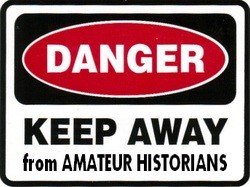
Keep AwayOne of my first editing jobs, back in the day, was for an amateur historian of the Retired Teacher variety.

A music teacher, too, so I don’t quite know why he turned to history of all things – but so he did. He started doing his own field research, and after a while, decided he had made earth-shattering discoveries, and must write a book. So he went to the one editor he knew of – me – and said that he wanted editing.

I told him one usually edits a book. A written book.

“I don’t care about usually. I want someone to follow me as I write. To bounce ideas with. To assist me all the way trought.”

Had I known any better, I would have run like the wind. But I didn’t, and not only accepted, but rather looked forward to it, as an interesting experience. It would be more like co-authoring than anything else – and I love history… what could go wrong?

Oh, so many things.

The fellow couldn’t write to save his soul, hadn’t the first notion about structuring  a paragraph – let alone a chapter or a whole book – and had a deep-seated aversion to archival research.

Why, why, oh why history, you’ll ask again. I was very soon wonderinRiverBookg myself – but the worst was yet to come. His theories at first seemed interesting enough, although there was no convincing him that he needed to support them somehow. Then one day, he sprang on me his Big Discovery: he claimed that, at some point in the 14th Century, the local lords had had the largest river in Italy moved. Secretly and more or less overnight. So very secretly that no one had realized in seven centuries…

I was flabbergasted. When I found my voice again, I asked how on earth he thought he was going to prove this. He said he needed no proof: that was how it had happened, and it couldn’t have been otherwise. And all the other historians who hadn’t seen it, were either incompetent fools or lying scoundrels.

All of which he meant to say in his book.

For months I tried to dissuade him, or at least to have him do some research. I preached historiography methodology, I told him (real) historians would butcher him with relish… to little avail, at first – and right when I thought I was perhaps seeding a few healthy doubts in his mind, he went to a local vanity publisher, who pronounced himself interested, and started to pre-sell copies to local municipalities.

“Did he read your chapters?” I asked, on receiving the news.

No, the publisher hadn’t bothered. He had seen the maps and, apparently, fallen in love with the project. My amateur historian was ecstatic. The publisher understood him (as I did not, was heavily implied), and he was a publisher, he’d know, wouldn’t he?

Of this I had my doubts, but there was no chance the poor man would ever heed my warnings by then. So I did my best to beat his style in some appearance of readability, and to tone down the worst of the attacks on established historians, and that was it.

In due time, the book was published, and I was invited at the launch. I went – with many misgivings…

My poor amateur historian was no better speaker than he was a writer. He muddled his arguments hopelessly to begin with – and then the (real) historians – three of them – closed in for the kill. They were unamused at being called names in print. As was to be expected, they shredded the poor fellow and his theories to ribbons, even the less loony ones. Most of all, they laughed at his portable river, and at his utter lack of documented proof…

The publisher, when called upon, candidly said that he had never read the book, and that authors should take all responsibility for what they wrote.

It was a nasty, gory, unpleasant affair – and do you know how it ended? The amateur historian stopped speaking to me for a few years. Because, well, nobody is ever grateful to Cassandra, I guess.

Then he decided he could forgive me, and to this day, whenever we meet, he starts on it again: how he was misunderstood, and how all other historians were either fools or liars, and how it must have been the way he says – because it couldn’t have been otherwise.

I try to avoid the man as much as I can, and when I can’t, I nod, murmur and then flee – but goodness. Moving rivers is an interesting activity!
 

An Elizabethan Rainbow

04 Saturday Oct 2014

Posted by la Clarina in History

≈ Leave a comment

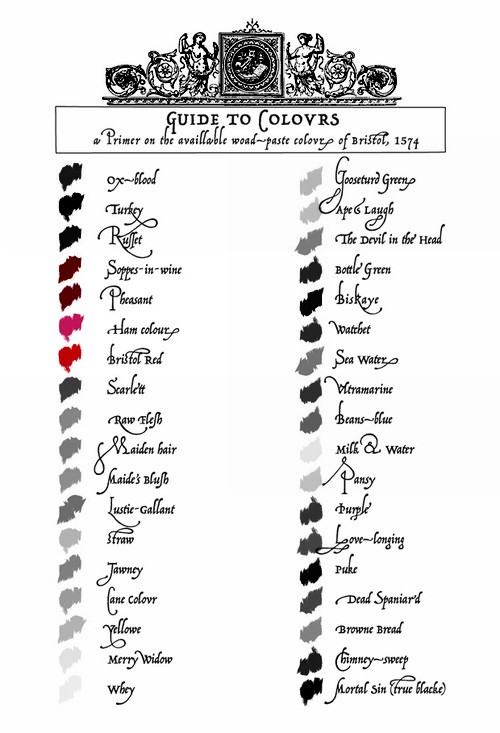
PrintIt was the names of the colours at first…

A handful of them I knew already – you don’t read Elizabethana for years without learning such picturesque names as Dead Spaniard grey, or Gooseturd green (incidentally, Robert Greene’s favourite colour, it would seem), but this list of the dyes available in 1574 Bristol is a wonder.

And then the whole of Elizabethan Trinkets is a mine of images and links: clothing, jewelry, architecture, objects, trinkets… I still have to really make friends with Tumblr blogs, but this one I like very much: interesting, pretty, and a delight to browse.

Killing Darlings

02 Thursday Oct 2014

Posted by la Clarina in Scribbling

≈ 3 Comments

Tags

Alexandre Dumas, Auguste Maquet, D'Artagnan, Porthos, writing

English: French writer Alexandre Dumas, pere.It is said that, when the time came to kill off D’Artagnan, Dumas couldn’t bring himself to do the deed, and had his right-hand man Maquet do it.*

It is also said that Dumas killed off Porthos in person – and wept like a baby over it.

I think I rather understand him.

I have vivid memories of killing off my first hero ever, some twenty years ago. I sat up late at night to write, and it was my insomniac father who found me in tears, and wanted to know what was the matter…

“I’ve just killed Ned!” I sobbed – and if Dad was amused, he covered it well. I remember the exhilaration of having reached the last page, and the awfulness of having pushed under a cab this fellow I had imagined, and followed from childhood to early thirties, and put through all sorts of ups and downs, and grown to love… But he had to die in the end for the story to make the sense I wanted it to make. And so I cried my eyes out, but push him under the cab I did.

Poor Ned.

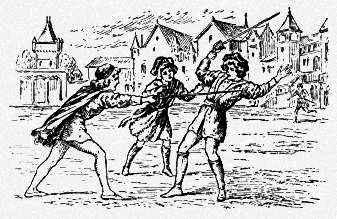
Back then I was very young and green at the game, but it would seem that, twenty years later, little has changed. Last weekend I reached the last-but-one, climatic scene of the opera libretto I’m writing for a composer. The scene involves a duel, in which my hero gets himself killed, poor lad. Now, don’t go and assume I kill of all my main characters… Oh well, I often do – but this time it isn’t exactly my choice. The libretto is a commission and a loose adaptation from someone else’s work, and I couldn’t change the ending, even if I wished.**

 Wait, wait, wait! Why don't we have another cup of tea, before we get drastic?

Wait, wait, wait! Why don’t we have another cup of tea, before we get drastic?

And yet, bearing all the above in mind, and having known from the beginning how it would end, I found myself dithering like mad, and tinkering past reason with the market scene that precedes the duel, and making myself multiple cups of tea – anything to postpone the fatal blow a little longer.

In the end, it took me twentyseven hours to kill the fellow – an inhuman length of time, I’ll agree – and I may not have teared up, but I very much wanted to. Like my much younger self. Like Dumas. Like, I’ll wager, a whole lot of writers.

Let no one tell you writing isn’t gruesome work. We do a lot of darling-killing, and it’s not always all that metaphorical. We make up people, we grow to know and love them – and then we kill them, and manage to be so very sorry about it.

Someone might call it not just gruesome, but weirdly so.

________________________________________

* Sounds terribly felonious, doesn’t it? Actually, Auguste Maquet was a history teacher and a very minor novelist, who earned a living as a sort of writing assistant to Dumas. It didn’t end well.

** Not that I do: it makes such perfect dramatic sense…


And a Bit with a Dog

27 Saturday Sep 2014

Posted by la Clarina in Theatre

≈ Leave a comment

Tags

christopher marlowe, Declan Donnellan, Lee Hall, Noël Coward Theatre, Shakespeare in Love, Tom Stoppard

SilbAre you in London? Or reasonably near?

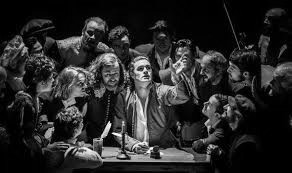
Then do go and see Shakespeare in Love – the stage version – at the Noël Coward Theatre.

I was not reasonably near – I flew from Italy to London and back again within forty-eight hours (while nursing a huge cold) for the sake of this play, and oh, was it ever worth it!

Much as I love the film, the stage version is better. Much better, in fact – with superb musicians onstage (one of them a fabulous countertenor), Declan Donnellan’s smart, lovely direction that makes the most of a set gorgeous in its simplicity, great performances from everyone, and above all an adapted script that centres everything firmly on theatre – and partly does so by expanding Kit Marlowe’s role. Oh, and of course there is the dog…

Can one ask for more?

Have a look at the trailer, read playwright Lee Hall’s thoughts on writing the adaptation, and then go see for yourself.

Related articles
  • Shakespeare in Love, Noël Coward Theatre – review: this adaptation has a fizzy, infectious exuberance (standard.co.uk)
  • Shakespeare in Love at the Noel Coward Theatre (thetimes.co.uk)

Historical What?

25 Thursday Sep 2014

Posted by la Clarina in Books, History

≈ 3 Comments

Tags

Caroline Stevermere, Fantasy, Genre, Historical fantasy, Lisa Barnett, Melissa Scott, Patricia Wrede, Susanna Clarke

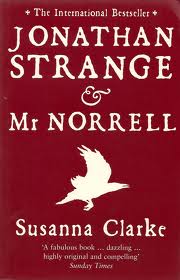
StrangeBack when I read and loved Susanna Clarke‘s wonderful Jonathan Strange & Mr Norrel, I didn’t even know there was such a thing as historical fantasy.

It took me years, and the HNR, and keeping bad company to discover the genre, and develop a keen interest for its Elizabethan and Napoleonic sides. Let’s mention Wrede and Stevermere’s delighful Kate&Cecelia books, or Scott and Barnett’s equally wonderful The Armor of Light – just to mention a couple of favourites.

As I may have said before, I love the games one can play with history, and adding in magic – whether or not in the way it was understood and believed to work back then – sounds like a very good game…

Trouble is… well, it’s not really trouble, if you like – because every genre or subgenre is bound to have a broader sense and a few blurry corners… Still, I find I’m a bit disconcerted at the latitude of interpetation that is sometimes attached to historical fantasy. I’ve seen G.R.R. Martin’s Chronicles of Fire and Ice described as historical fantasy… I must say I have never finished the first volume of the Chronicles, but even so, I doubt they have any conceivable claim to historical fantasyhood, other than being plotted after the War of the Roses…

Is that enough? And if so, what’s to distinguish historical fantasy from all the fantasy set in some quasi-Medieval, quasi-Renaissance, quasi-Period-of-your-choice world?

A possible answer is: who cares? Who cares how a book is tagged – as long as it is a good book?

Yes, welll, there is that – but still. On the one hand, there is the matter of what I like and I don’t like, and while I’ll admit that having to hunt for “my” kind of historical fantasy through heaps of covers sporting ladies in tolkienenesque garb chatting up dragons before Neuschwanstein-like castles in pastels* is a very minor pain, seeing candy-coloured versions of the Middle Ages labeled as historical is… not. And I won’t even begin on historical perspective here**. What gives me pause in this is the publishing angle. What is the target? Is the reader of historical fantasy supposed to love indiscriminately Napoleonic dragons, Medieval fantasy, Elizabethan alchemy, and century-hopping vampires? Or is the genre just a provisional umbrella tag, waiting to splinter into a constellation of subgenres?

Would it bother me as much if I weren’t tempted to try my hand at it? Or if I weren’t this obsessed with history? WHo knows – but, things being what they are… Just wondering.

__________________________________

* Want to make a little experiment? Try searching for “historical fantasy” on Google Images or Pinterest…

** And I might, mind – I just won’t right now. I call this admirable restraint.


Related articles
  • Epistolary fantasy that will make you smile: Patricia Wrede and Caroline Stevermer’s Sorcery and Cecelia (tor.com)

The Old Music of Words

20 Saturday Sep 2014

Posted by la Clarina in Books, History, Scribbling

≈ 2 Comments

Tags

Farrar Straus and Giroux, Hild, Historical fiction, Language, Nicola Griffith, Work in Progress

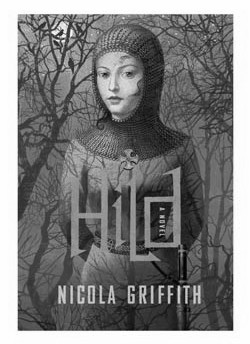
HildI confess, I haven’t read Nicola Griffith’s Hild. But I most certainly will, after finding  (in Farrar, Straus and Giroux’s blog Work In Progress) this excellent article about the research and thought process that went into crafting the novel’s language.

I greatly admire Ms. Griffith’s vivid depiction of her approach to… not so much recreating period language, as rendering its feel – and its social and psychological implications as well.

So much so that Hild’s time period may not be my favourite, but I just have to read a book written this way.

I’ll let you know.

Related articles
  • With Nuanced Beauty, ‘Hild’ Destroys Myths Of Medieval Womanhood (npr.org)
  • We All Have Our Magical Thinking: An Interview with Nicola Griffith (theparisreview.org)

Leaving Traces

18 Thursday Sep 2014

Posted by la Clarina in History, Theatre

≈ 2 Comments

Tags

Hannibal Barca, Mathilda of Tuscany, Second Punic War

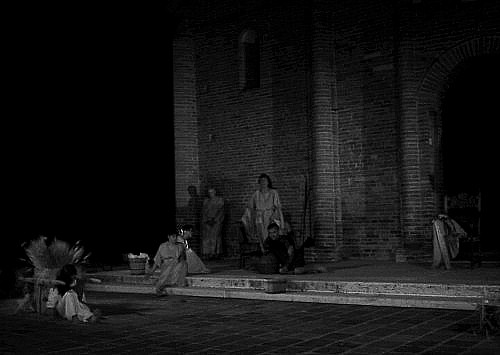
hereOne of my last forays on a stage was to play the double role of Beatrice of Bar and a peasant girl in a historical play about Beatrice’s daughter, Mathilda of Tuscany – the great lady of the Italian Middle Ages.

It wasn’t exactly my idea – but the company was one Beatrice short after a last minute forfeit, and the peasant girl was thrown in for good measure, and I’ve never been terribly good at saying “No”…

Anyway, to make a long story short, I was there when Mathilda – Woman and Countess, was played, very appropriately, before an 11th Century church originally funded and founded by Matilda herself.

We had someone really good taking care of the lighting, and a suitably windy night – enough to stir the many cloaks, but not enough to mess with the mikes. So the play was lovely to look at, and we were all rather happy with the result.*

And after it was all over, I stood there with the director (who had also worked with my Carthaginian play) watching the lovely romanesque façade, as the crew took down the lights. It was a beautiful sight.Untitled 1

“See?” the director asked, pointing. “Your Hannibal, he left behind nothing of the sort.”

Which – as I admitted then, and have no trouble admitting now – is absolutely true. Hannibal didn’t leave behind anything of any sort, when it comes to brick-and-mortar – except perhaps the town of Artashat, that he may have designed for a king of Armenia, but even supposing it is true, the ancient Artashat now is less than ruins.

And this, theatre-wise, makes Hannibal by far the most interesting of the two – or, at the very least, the more tragic.

Come to think of it, there are similarities between Hannibal and Mathilda. Both were born to rank and privilege, both soon proved exceptional, both took on their roles very young, both had remarkable fathers they lost early and far exceeded, both played pivotal roles in the clash between the two great powers of their time, both left no heirs…

But Mathilda died leaving a reasonable approximation of peace and all kinds of tangible legacy, and having accomplished much of what she’d set out to do, after reigning for many years. Hannibal, on the other hand, died a defeated, hunted, betrayed exile, took his own life to avoid capture, and left… nothing.

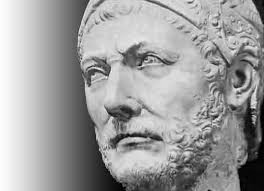
HanNothing except a name that even his worst enemies admired – if grudgingly. Nothing except tactical notions that are still studied in military schools all over the world. Nothing except, and here is a paradox, the greatness of his enemies – because it was with the II Punic War that Rome graduated from power to Power.

And so, I’m sure Mathilda was a very remarkable lady – but my heart and my imagination root for the man who, defeated and with no monument to leave behind, managed to throw his name across more than two millenia – out of sheer, burning, titanic greatness.

____________________________________

* Well, with the possible exception of the author – another playwright, who never forgave me for saving the performance by stepping in at the last moment… But this is another story.


Related articles
  • Lecture | Patrick Hunt: Hannibal’s Secret Weapon in the Second Punic War (rogueclassicism.com)
  • In Carthage (lrb.co.uk)

In Memoriam: Magda Olivero

13 Saturday Sep 2014

Posted by la Clarina in Stories

≈ Leave a comment

Tags

Magda Olivero, Opera

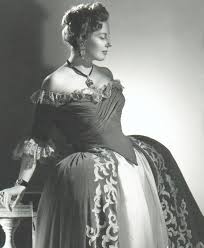
MagdaMagda Olivero died last Monday at 104. She was a wonderful soprano – though not of the usually acclaimed torrential sort. She had a very distinctive voice, flawless technique, and an infinite capacity for refined, intense, detailed, deep interpretation. She wasn’t over-demonstrative, she wasn’t sentimental in her singing, she recorded sparingly, and she had an amazing longevity, when you consider that she sang in public for little less than seventy years.

She also was a delightful person, witty, intelligent, and sharp as a tack. I only met her once, well in her nineties, but she was something of a household name, being my mentor’s operatic idol and good friend.

And in memory of her intelligent artistry, I like to remember her here.

Here you can read a lovely article about Magda, by Deceptive Cadence‘s Tom Huizenga.

Why don’t you write something contemporary?

11 Thursday Sep 2014

Posted by la Clarina in Scribbling

≈ 3 Comments

Tags

Historical fiction

DSN2Indeed, why don’t I?

Through the years, I have published three historical novels – slightly unconventional ones, perhaps, but still. And I’ve had six plays staged, five of which are set at some point in the past.

And at every launch, at every book signing, at every performance, some well-meaning soul turns out with The Question: why don’t I write something contemporary? And the funny thing is, they usually mean it as a compliment.

As though writing historicals were some sort of second best, ‘prentice work I’ll have to outgrow, sooner or later. Oh, what a lovely book/play. You are ready now, dear girl. You can go on to write something serious…

And nine times out of ten, it is perfectly pointless to say that I am writing what I want to write, thank you very much. Or that it’s not that I cannot write present-day – it’s just that I don’t like it all that much.

After all, I write historicals for a reason. Several reasons, actually: the difficult task of really grasping past events, a fascination with the things we don’t know anymore, the way legends, clichés and literature grow layer after layer, the pull of  century-old lies, the constant tension between period-ness and interpretation… All of which, you’ll agree, is better explored by writing historical fiction.

So, it seems to me that I know what I am doing – and why I do it – but no. Let it be publicly known that I write historicals, and someone is bound to ask: why, why, oh why, don’t I write something contemporary?

Well, maybe because I don’t care to? Because I don’t feel I have much to say or tell in a contemporary setting? Because I’m better at other things?

And I’m not saying I’ll never do it. Apart from the fact that writers have been known to change their minds, I’m never averse to dabbling with genres outside my own, trying something different. Stepping (cautiously) out of my comfort zone… So, who can tell what the future will hold?

Meanwhile, though, nothing contemporary, thank you – and no sugar.

A Gladius by Any Other Name?

06 Saturday Sep 2014

Posted by la Clarina in History

≈ 3 Comments

Tags

Aculeo & Amunet, Davide Mana, Historical fiction, Karavansara, Lindybeige, Schola gladiatoria, Skallagrim

gladius-training-sword-largeThis is from Karavansara, my friend Davide Mana’s great blog of pulp and historical adventure, with an Asian slant. It’s not for nothing that Davide subtitled the thing “East of Constantinople, West of Shangai.”

While doing research for his wonderful Aculeo and Amunet stories (check them out, if you’ve never read them), he stumbled across some great video resources about ancient weaponry, and collected a few in this post.

When you are writing historical fiction (or historical adventure), you never have enough of this sort of things – because it’s damnably easy to mess up… And of course, a novel is a novel, and not a treatise on ancient hoplology – but it’s so much better if, while providing great characters engaged in interesting action and meaningful stories, you also get your swords right, isn’t it?

Related articles
  • Aculeo & Amunet – the official website (karavansara.wordpress.com)
← Older posts
Newer posts →

Seek and Find

♠ THE TOM WALSINGHAM MYSTERIES

Available on Amazon
Available on Amazon

The Copperfield Review’s first anthology – containing Gentleman in Velvet

Recent Posts

  • For Queen and Country: Tom Walsingham at the HNR
  • A Snare of Deceit is out!
  • A Deadly Complot
  • Merry Christmas!
  • Death in Rheims – Publication day!

Popular Scribblings

  • What Ought to be Truth
  • Music in a different language?
  • The Tale of the Nail
  • Alexandros, after all
  • Little Shakespeareans
  • Bad King John

Categories

  • Books
  • Eccentricities
  • History
  • Lostintranslation
  • Poetry
  • Scribbling
  • Silents
  • Stories
  • Theatre
  • Things
  • Uncategorized

Enter your email address to get a messenger on horseback... er, an email will reach you by email when a new Scribbling is out.

Join 311 other subscribers

RSS Feeds

  • RSS - Posts
  • RSS - Comments

No Blog’s an Island

Sapere Books


IBA

International Bloggers' Association

I tweet on Twitter

And I pin on Pinterest

Senza Errori di Stumpa – my Italian blog

Create a free website or blog at WordPress.com.

Privacy & Cookies: This site uses cookies. By continuing to use this website, you agree to their use.
To find out more, including how to control cookies, see here: Cookie Policy
  • Subscribe Subscribed
    • Scribblings
    • Join 311 other subscribers
    • Already have a WordPress.com account? Log in now.
    • Scribblings
    • Subscribe Subscribed
    • Sign up
    • Log in
    • Report this content
    • View site in Reader
    • Manage subscriptions
    • Collapse this bar
 

Loading Comments...