
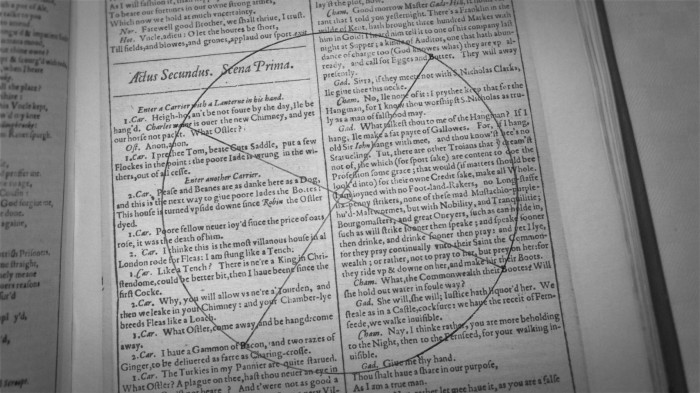
 So, Petter Amundsen is this Norwegian organist, freemason,”dabbler in occultism”, and steganographer, who claims he found evidence that Sir Francis Bacon wrote Shakespeare’s plays – and found it in the First Folio.
He’s not the first. Delia Bacon started that back in 1857, based on a combination of “discovered” cipher and quasi-mystical hunches*, and hordes of cryptographers have pursued her trail ever since, “uncovering” all sorts of hidden messages in Shakespeare’s works.
Usually, the Bacon side of the Authorship Question lithobrakes against little facts such as the huge difference between Bacon’s own style and Shakespeare’s, or Bacon’s life – a very busy one without throwing in some forty plays…
Amundsen sidesteps these objections by saying that why, yes – but then, who wrote Shakespeare is not the real question…
And this, you’ll agree, is… well, unusual. Then again, Amundsen is not so much an anti-Stratfordian as a conspiracy theorist. He claims that, whoever wrote Shakespeare, did so to forward the Rosicrucian goal of a “universal reform of Mankind”. And who was the leader of the very, very secret order of the Rosy Cross – so very secret that its very existence is none too sure? But Francis Bacon, of course! Anyway, in 1623, whoever was behind the publication of the First Folio (and Bacon just happened to be a master steganographer…) had a number of clues encripted in the printed text – clues leading to the treasure buried on Oak Island, off the coast of Nova Scotia.
What treasure? The lost menorah from the temple of Jerusalem, and Shakespeare’s original manuscripts – preserved in quicksilver.
Shakespeare – The Hidden Truth is a documentary movie telling the tale of Amundsen’s research in company with an English PhD student – and ortodox Stratfordian – who starts ofs as a sceptic and ends up… with doubts. And it is a nice, well made, exciting movie, and it shows a huge quantity of coincidences, but…
But, even discounting my own penchant towards Stratfordian ortodoxy, I can’t help wondering: whoever wrote Shakespeare**, how would he (or they) know what to write so that the right letters and words would combine into the required symbols and clues right on the various pages 53 in the printed version, decades later?
You could say they didn’t, and tweaked the text in 1623. Right – and Amundsen shows some instance of what could look like tampering with page numbers. But I suspect that something more would be needed to achieve all those triangles, constellations and acrostycs… So, how about the Quartos? Does a check against these much earlier editions show enough tweaking in the relevant parts of the First Folio to support Amundsen’s theory?
Still, my biggest doubt remains: why?
According to Amundsen, the original manuscripts are hidden underground, somewhere on Oak Island, preserved in quicksilver for eternity – but why?
Supposing Francis Bacon and his nephew, on behalf of the order of the Rosy Cross, wrote or commissioned Shakespeare’s plays, and hid there the key to the treasure hunt, why go to all this trouble?
Why bother to hide half a world away something whose importance actually resides in the printed version? That is, if the menorah is the prize – and we must assume so, because frankly, Shakespeare’s manuscripts may be the holy grail of literature to us, but back then, they were just Shakespeare’s manuscripts.
No, really. I doubt anyone, in Elizabethan or Jacobean times, thought of theatre in terms of eternity… Plays were written and consumed fast, publication (and in folio!) was the high mark of success, theatre was hardly what a poet wanted – or expected – to be remembered for.
The notion sounds distinctly anachronistic. But then, it also sounds very much like a locked case containing its own key, doesn’t it?
So yes, I’ll admit coincidence seems to be there in abundant quantity – but then, when you look for coincidence, you usually find it – and all the rest apart, I remain with eyebrows raised, and a lot of questions unanswered.
____________________________________________
* When she crossed the Pond, she famously perplexed her British supporters by all but refusing to see any Shakespearean or Baconian documents. She preferred, she said, to imbibe the atmosphere by taking strolls in what she thought to be the right places…
** And Amundsen seems to allow the chance that Shakespeare wrote his own plays, after all – but at the behest of Sir Francis Bacon.
 Scribblings