Tags
 I wish you all, o Readers, a wonderful 2014, full of writing, ideas, discoveries, good chances, good books, good friends – or let’s not be too specific: I wish you a new year to match your notion of happiness!

01 Wednesday Jan 2014
Tags
I wish you all, o Readers, a wonderful 2014, full of writing, ideas, discoveries, good chances, good books, good friends – or let’s not be too specific: I wish you a new year to match your notion of happiness!
31 Tuesday Dec 2013
28 Saturday Dec 2013
Tags
authorship question, christopher marlowe, Elizabethan era, William Henry Ireland, William Shakespeare
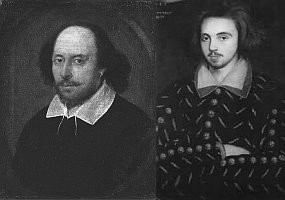 Did you notice? The Shakespeare Year is right around the corner.
Shakespeare & Marlowe Year – thank you very much, because let us not forget those two were born a few months apart. A good harvest when it came to playwrights, 1564 was…
And I’m getting ready. This will be an intensely Elizabethan year for me. I’m going to blog about it – so be warned: lots of Shakespeare and Marlowe to come.
And then there are, if all goes well, the Sonnets play, and a few others I have in various stages of readiness – including a radio drama – and another I want to write.
And a school project involving A Midsummer Night’s Dream.
And the lectures. I’ve sent and I’m still sending around to libraries, reading groups, schools and everyone I can think of that might even remotely be interested – offering my… shall we call it my array* of lectures on Shakespeare, Marlowe, Elizabethan England, Authorship Question, William Henry Ireland, Sonnets, espionage, School of the Night, whatnot…
So yes – as I said, this is going to be an intensely Elizabethan year. And believe me: you are going to hear about it.
__________________________________________
* Yes, we shall: I love the word.
24 Tuesday Dec 2013
21 Saturday Dec 2013
Posted in Scribbling
 I beg to differ from the Bard on this: I’m not all that sure a rose would smell as sweet if it were called, say, benzopyrene. Or, even if it did, would you really smell it to make sure?
Names matter. Names are not all the same.
And yes, I confess: I’m the sort who will stay after the film is ended, to read the names in the end credits. The sort who will sift through obituaries, other people’s old class lists and spam mail for names. The sort who, when playing D&D at sixteen, could agonize for weeks over the name of a Level 1 elf…
When I start writing something new, names are all important. I can spend hours poring over name lists in dictionaries, seeking The Right Name. And it’s hardly ever a matter of meaning. Mostly, it’s the sound. And of course, when writing historicals, other considerations weight in the choice, such as time period, custom and social suitability – but all the same, the name must sound right for the character.
Oddly enough, I don’t always choose first names I like. I’ve foisted on beloved characters names I’d frankly hate to bear, while some names I love never proved right for any character of mine. Odder still, last names work differently: they must not only sound well with the character’s first name – for some reason, I want to like them.
All this to say that there is this novel I’m slowly revising, in which two main characters bore names starting with A, and three different beta readers suggested that I should change at least one. It seems it’s not a good idea to have different characters’ name begin with the same letter. Readers might get confused.
Yes, yes – I know: I think I’d take offence too if anyone implied that I can mix up two very different characters just because they share an initial. And yet… what if someone got confused? What if they had to check again and again to make sure who’s who? What if they threw the book away before page thirty – because they can’t tell characters apart? Not good, is it?
So in the end I decided to give up one of my oh-so-carefully chose names, and I’m not enormously happy, because one I like, and the other is perfect for the character, and no amount of list sifting has yet produced a good alternative for either…
And no: my characters don’t smell as sweet by any other name. Why, one of them has even changed face in my mind – all because of the name I’m not sure I’ll keep… I dare say that, for once and as far as I’m concerned, Shakespeare just might be wrong.
14 Saturday Dec 2013
Posted in Scribbling
 Would you believe it is December again?
Yes well, by now it is the middle of December again, but the fact remains.
And I love December – I really do, but all the same I must admit that writing-wise it is a downright dreadful time. You know how it is. Work crowds, because it seems They cannot live unless you give them one more translation, one more piece of editing, one more whatsit before Christmas. And then there are Christmas preparations – which we take very seriously – and shopping trips to town, and Christmas concerts, and Dickens and Tchaikowskij, and then guests begin to arrive…
And yes, it is partly my fault for embarking every year on ludicrously intricate decorating projects, stubbornly baking my own lebkucken cookies and Christmas pudding, trimming two large trees… but the thing is, writing time is in short supply.
And if the shortage weren’t enough, Christmassy ideas keep hitting me smack in the eye: it’s not as if I hadn’t plenty of projects going and deadlines looming, and yet, what do you think I do when I can snatch an hour? Work on my new play? Tweak my almost-completed three-act thing? Make up lines for my opera libretto?
But no – not on my life: there is this little new play set around Christmas Eve, and then, late at night, while I cut and pasted cardboard ornaments for the tree, a notion for a short story blossomed out of an old play, and how can one disregard a new notion for a short story?
And last night, while dining out with friends, a casual piece of conversation sparked off something like a very wintery ghost story – and I just had to sit up very, very late jotting down at least a shadow of an outline…
Which is why I’m hard put not to laugh whenever someone wonders where I find ideas to write, and why I have learned, over the years, to give up December writing-wise, and roll with the cinnamon-scented current. December is December, after all, and another January will be here all too soon.
07 Saturday Dec 2013
Tags
The youngest by far, the only woman, and without much in the way of academic laurels, I knew I was the smallest fish in the tank.
Still, I loved the project, and the chance to publish a translation side by side with essays by a few rather exhalted names seemed almost too good to be true. So I worked hard – not only on my own translation, but helping substantially with at least one other, transcribing whatever needed transcription, doubling as a last-minute proofreader, and so on, and so on.
And I was very happy when the curator said that my name must be on the cover as co-curator.
Then things happened, so the book was published in some haste after all, and even more hastily launched – and my name as co-curator was nowhere to be seen. Circimstances were rather special, though, and a real launch was expected to take place later in the year, and so I didn’t protest too much. Smallest fish, remember?
Months went by, and more things happened, and the “real” launch was decided and postponed several times – or so I thought, until a friend told me how she was coming to the launch next week, and was very happy for me…
I was dumbfounded. The launch? Next week? And nobody had thought to let me know? I called the curator, and complained. He was immensely sorry, his wife was unwell, the preparations had been frantic, he didn’t know how he could have left me out…
“Tp think you could have taken so much of the weight off my shoulders!” he concluded with disarming candour.
Now the curator is a rather ancient University don, a vague and generally very nice old gentleman, with this very sickly wife… I really had no heart to be cross with him. And true, the publisher is neither ancient nor burdened with a sickly wife, and invitations had been printed and sent with no mention of poor little me… and you are thinking I am a goose, and I should have made myself heard, aren’t you?
But you are right, I’m a goose. A small, white one. On the appointed day I went to the launch. There were the curator, the publisher, the two main contributors, the president of the local Accademia, and an unrelated speaker… They launched the book, explored its subject, showered each other with compliments…
And do you think it occurred to any of them to remember the co-curator, to at least let the audience know that such and such a small fish had swam with them in their tank at all?
They knew I was there, they had seen me – and, even if they hadn’t… I’ll admit I’m rather bitter about it. But perhaps this will be a salutary lesson to me, and I’ll stop sparing ancient curators when they all but appropriate my work, and will let other relevant parties have a piece of my mind before things happen, and stop being a damn nice girl. Or fish. Or whatever.
30 Saturday Nov 2013
Posted in Stories
No, not Lana Del Rey.
Sooner said than done…
Last week, our creative task for The Future of Storytelling, was to discuss the storytelling in our favourite videogame.
And guess what? I don’t have a favourite videogame.
Actually, I have played very few videogames in my life, and none of them with anything like a real narrative structure. Which is rather odd, come to think of it, because I am the one who needs a story in everything she does. Why, I never could play a game of Monopoly without adding a story to it. In my College years, I used to attach stories to every game of pinochle: sometimes it was the Vandean Wars, sometimes the Jacobite Risings, sometimes the Anglo-Boer Wars, but mostly the Revolt in the Desert*. You’ll laugh, but even while playing solitaire on my laptop – a dreadful procrastinating strategy – I tell myself stories to go with it.
My cup of tea…
So, I guess that for me the trouble comes with the mechanics of videogames themselves? My eye-hand coordination isn’t too terrible, usually – but, for some reason, when it comes to moving around with a mouse, a keyboard or a joystick, I suddenly grow ten thumbs and a lot of cottonwool in my brain. It’s not that I never tried, I’m just unbelievably bad at it.
I remember playing I don’t know what fantasy videogame with friends, when I was fifteen or so. My elf was a walking danger, because I would mix up my keys and start shooting arrows with wild abandon at the wrongest moment… After I killed all my team-mates for the fifth time, we went out for icecream, and never played again… Not that I minded too much: when I’m too busy minding my keys to enjoy the story, I bore very, very easily.
And so, I stuck to paper-and-pencil RPG, and the occasional very easy single-player game in which I could click and point, and tell myself stories as I went – because yes: the short and the long of it seems to be that games are all very well, but woe to the game that comes between me and my story.
____________________________________
* I’m told that, as a result, in my College jokers went under the name of vickers for years…
23 Saturday Nov 2013
Tags
#StoryMOOC, Arnolfini Portrait, christopher marlowe, Conrad, Daughter of Time, Jan Van Eyck, joseph conrad, Josephine Tey, Lord Jim, Rodney Bolt
And so it happened that the creative task for week 4 of StoryMOOC was to put together a small video, with a list of one to three books, movies, paintings or whatever that we find especially inspiring – storytelling-wise.
The hardest part, frankly, was choosing just three of them – but the choice was an interesting exercise in itself.
I spent nearly five days wondering: which three pieces of inspiration would I most care to share? Which three books, movies or whatever do I want to recommend to other storytellers?
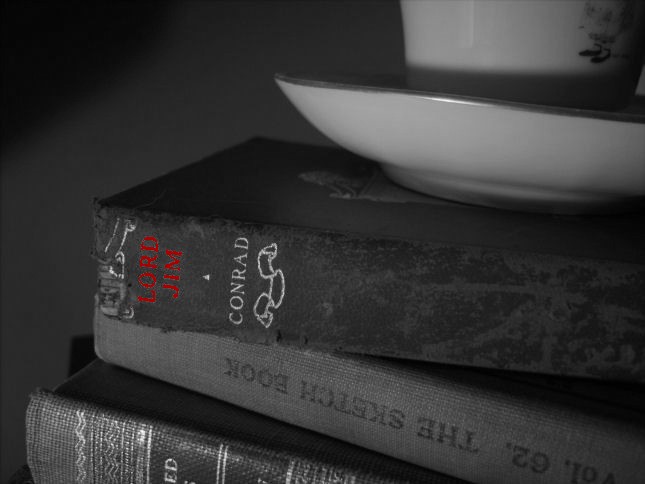 The first one, actually, was very much a given: Joseph Conrad‘s Lord Jim is the book of my life, and the standard of literary quality I aspire to, and an endless source of wonder. It was also an eye-opener the first time I came across it, with its intenseness, psychological depth, poignancy, complexity… It also made me fall in love with English, when I was eighteen – and thus very likely changed the course of my life. All else apart, as a non-native speaker, I rather hero-worship Conrad, who learned English in his twenties, and learned it well enough to become one of its great storytellers…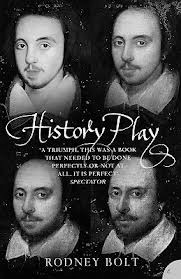
My second choice was less obvious, but I wanted something to do with my love of history and history’s fictional treatment. I dithered between Josephine Tey‘s The Daughter of Time and Rodney Bolt’s History Play… Bolt won the day in the end: his not-quite-novel plays with a growing distance between facts and their telling, documents and their interpretation. It plays with readers’ expectations and trust. There’s a lot of food for thought in this book – especially about the iridescence of history, a pet theme of mine. Besides, I am thankful to Rodney Bolt for sparking up my interest in Christopher Marlowe.
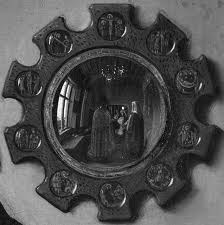 The last item in the list was, as usual, the hardest to pick. So many inspiring pieces, and just one slot left… In the end I settled on a detail from Jan Van Eyck‘s Arnolfini Portrait, the one you can now see at the Portrait Gallery in London. There is a round mirror on the wall, behind the merchant and his green-clad bride. The mirror shows the Arnolfinis from behind, and the window lighting the scene, and the door where the painter is working at his easel – and another small figure: the viewer. I’ve always loved it: the mirror shows the story, the storyteller at work, and the viewer/reader/listener – all together. I find it a perfect symbol for meta-literature and meta-theatre, both of which I love dearly.
So in the end these were the relevant inspiration I wanted to share – all of them well steeped in the past, aren’t they? Perhaps, it strikes me, a rather strange choice for The Future of Storytelling. Then again, I’ve always been more of a keeper than an innovator… after all, the nature of my inspiration comes as no great surprise.
18 Monday Nov 2013
Here we go. My Conrad thing goes onstage tonight, and I’m all aflutter and ajitter…
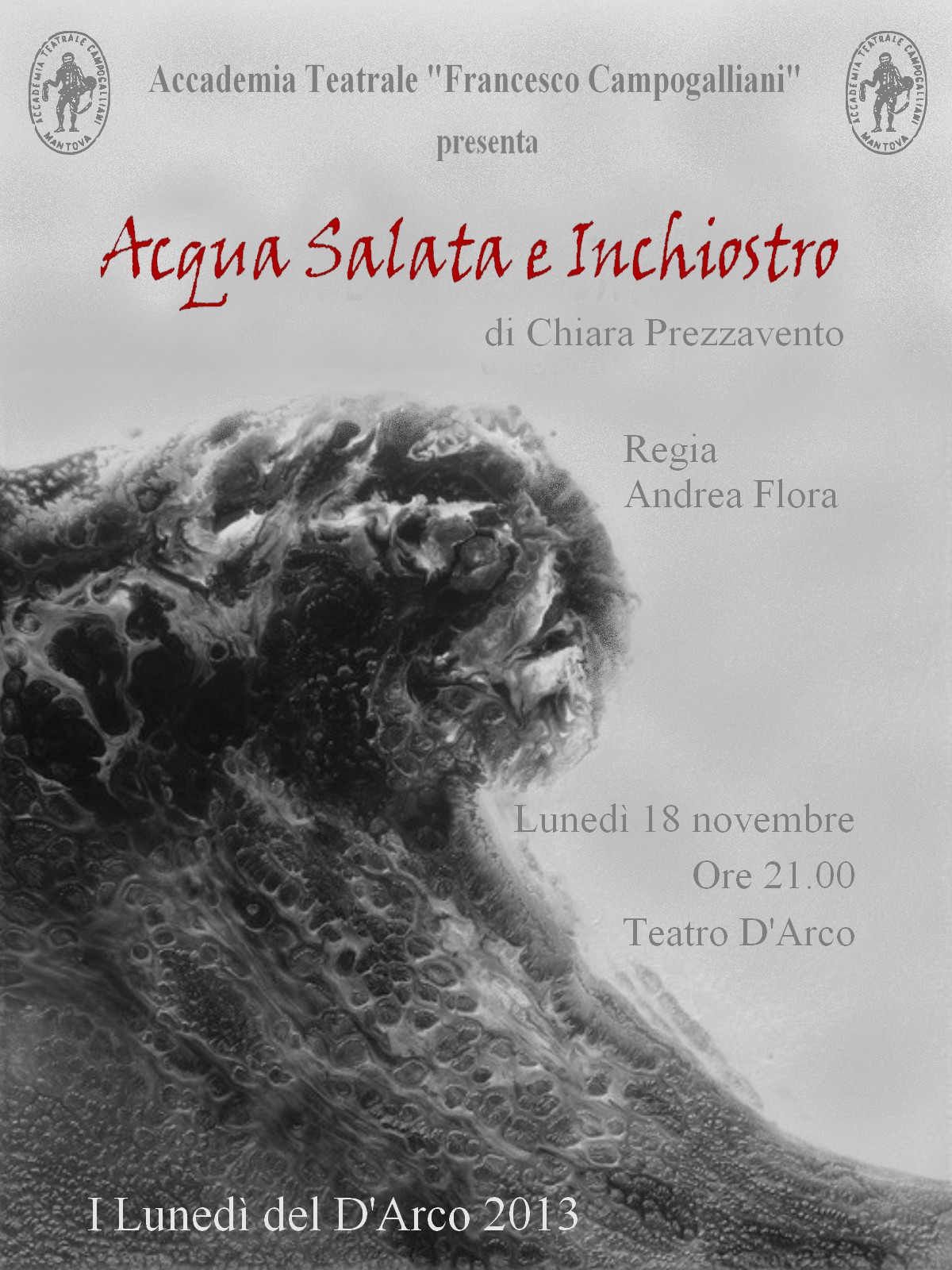
And here‘s a link to the Pinterest Board I made for this project…
Wish me luck.
Posted by la Clarina | Filed under Theatre
 Scribblings