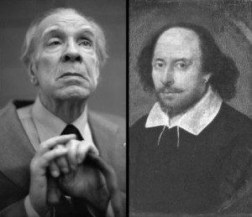
 In a slightly roundabout way I’ve come across a short story of José Luis Borges called La Memoria de Shakespeare, that is, Shakespeare’s Memory.
It’s a beautiful story – and by now I should know that, whenever I cross paths with Borges, I come away with wonders and discoveries. It starts, in a way that put me in mind of Kipling, with a rather dull Shakespearian scholar who, over dinner, gets offered the gift of Shakespeare’s memory. There are warnings – it will be hard, it will be dangerous… but frankly, would you refuse such an offer?
Hermann Soergel doesn’t, and in the following weeks find himself gradually flooded by Shakespeare’s memories, knowledge, likes and dislikes… I won’t tell you how it ends. It’s a pretty eerie ending, though not unexpected, but that’s not the point. The point is that, Borges being Borges, the story becomes a chance to illustrate the author’s… I was going to write “the author’s theories on Shakespeare”, but it’s not quite it. Borges is no Wilbur G. Zeigler or Gene Ayres, trying to smuggle some bizarre theory in fiction’s form. On the contrary, he adds layers and depth to a fictional story with a handful of unprovable but beautiful intuitions.
Here is my favourite:
I know that for Shakespeare the moon was less the moon than it was Diana, and less Diana than that dark drawn-out word – moon.*
I love it. This is Shakespeare in twenty-five words. Not Shakespeare’s works, but 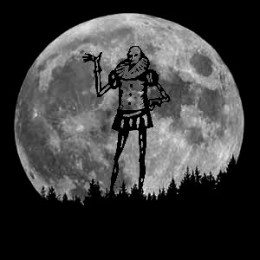 who Shakespeare was – or may have been. The Grammar Schoolboy with enough Latin and rhethoric to identify the moon with its mythological counterpart – but, more than that, the man with the exquisite ear, the poet who sees sounds, and uses each word as a brush-stroke. Borges is a genius.
Moreover, this gem of characterization doesn’t come just like that. It’s one of the tidal waves of Shakespeare’s mind flooding the narrator’s. You can almost see him – Hermann Soergel, absentmindedly watching the moon, one summer night, and suddenly he catches his breath as the alien awareness invades him. Diana first, and then the silvery light, the half-gloom containted in the “dark drawn-out word”.
I’ll say it again: it’s beautiful. Shakespeare imagined – seen – by moonlight. I do love Borges.
___________________________________
* Translation by Andrew Hurley.

 And so it is that the Squirrels’ Shakespeare is beginning to shape up and blossom.
 I think I’ve mentioned this before – but, as a Saturday thought, I’ll post a bit of the Author’s Greeting from George Garrett’s Entered from the Sun – the Murder of Marlowe.
 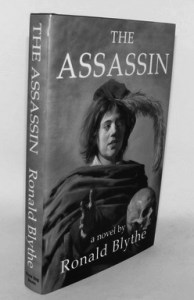 I had never read anything of Ronald Blythe’s before, and The Assassin was one of those serendipitous finds. I’m glad it happened, because it is a wonderful book.
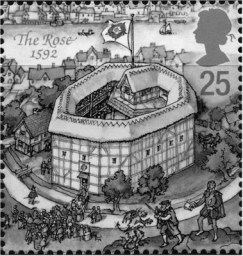 Henslowe’s Diary as a blog? Daily life at the Rose Playhouse?
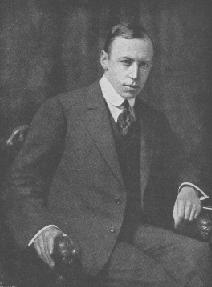 Alfred Noyes wrote a good deal, and in many genres. A poet, novelist, sci-fictioneer, essayist and pamphleteer, he was especially famous for his narrative poems – first of all the highly melodramatic The Highwayman.
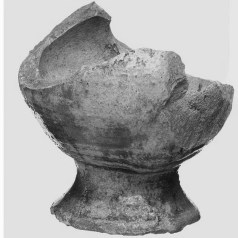 So they are excavating the Curtain, Burbage’s “other” Shoreditch playhouse, where the Chamberlain’s Men played for a couple of years between the Theatre and the Globe. The place was thought to have been Shakespeare’s “Wooden O” in the prologue to Henry V, and there was much rejoicing when in 2012, its remains were found…
  A little Saturday thought, from Milan Kundera’s The Curtain.
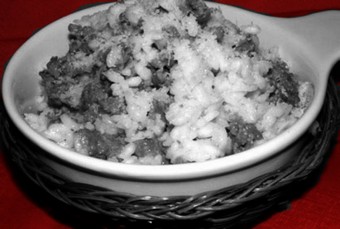 First, you have to know that a risotto is a first course of rice cooked with a variety of ingredients. In my corner of Northern Italy, it’s pork sausage and grated parmesan, basically – and it’s not just a staple food. In the words of my friend Milla, who moved here nearly twenty years ago, “it’s far more than a dish. It possesses quasi miraculous powers. It sates hunger, cures all ills, seals friendships and celebrates any and every occasion.”
 Scribblings