
Now this was sparked by an exchange of mails with an archeologist friend. We came to discuss empires – falling and fallen, lost and surviving in shadows… which brought me to muse on my personal collection of Lost Empires – or, at least, of shadows I found, sometimes in strange places or in the pages of a book.
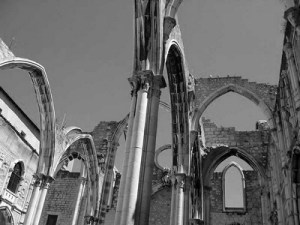 Lisbon, for instance, I found to be a strange place: melancholy, grand, and neglected, still dotted with ruins from the 1746 earthquake, with its tower overlooking the Tago, the cramped, untidy Alfama clinging around the crumbling castle, and caravels everywhere. Caravels are exhibited in museums, double as ex-votos in churches or children’s swings in parks, recur in trademarks and symbols everywhere… There is a sense of proud decay – as though the whole city whispered “let it all go to ruin, what matters now that the Empire is lost?
In London, on the contrary, you stroll along the Strand, surrounded by buildings named Australia House, Zimbabwe House, High Commission of India, Commonwealth Secretariat, Quebec Government Office… and although more than a century has gone by since Kipling wrote his Recessional, in tea-shops you can find boxes from all over the world, and Tuvalu still stubbornly refuses to have any other sovereign than the Queen of England, and the universities teem with Commonwealth children, and the whole city still breathes and beats with that sense of deliberate alacrity that fits the centre of the world. The British Empire may have disappeared from atlases and maps – but something of its spirit lives on.
 In Moscow, the Komsomolskaja square boasts three huge stations: early 1900s for St. Petersburg, the shape of a Yurt for the Transiberian, a decidedly Asian look for the Kazan line, and the neoclassical façade of an underground station. The square is very large, and some twenty years ago was constantly swarming with travellers. The cavernous halls were crammed with Russians and ex-Soviets of every possible ethnicity – dragging impossible amounts of luggage, sitting on the ground, drinking tea, shouting, pushing, elbowing their way around, pressing, quarrelling in a chaos of languages… That particular empire has crumbled more than once – but it left behind a living nerve-centre in the Komsomolskaja.
And then, after a number of hours in a rail car, you disembarked in St. Petersburg, where all facades are stunning – and behind them all is dirt and neglect. Again, I’m speaking of two decades ago, and I’ve no idea whether things have changed since. Back then, the whole city, with its perfect perspectives, the black colonnade of St. Mary of Kazan, the long, long days, the enchanting views – it all looked like theatre scenery, making you wonder whether Peter the Great’s notion of the Empire ever was truly more than that: a notion.
 Here’s a paradox: I first saw the Empire of Rome not in Rome – but in Lebanon. Well, I’ve seen Rome many times, and fallen in love a little more each time – and yet, whenever I’m there, admiring what is left of some ancient wonder, I can’t help wondering what would ancient Romans make of it if they could see it now. And the answer is, they’d find it a desolation: the stripped ruins of what they’d believed solidly unchangeable… Which is perhaps why, when I’m in Rome, I don’t like to dwell on the Empire too much. Baalbek, somehow, was an entirely different matter, with its huge, mighty temples that seem to claim: Rome was here – and claim it very loudly. Perhaps it’s because they are less blurred by later history there – but I found the footprints of the Empire in Baalbek to be quite solid, quite impossible to doubt.
And I have a couple more – but this is becoming a long post. Shall we continue next Thursday?
 Scribblings