
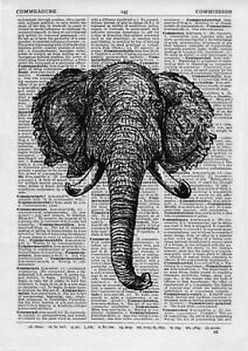
 Don’t you think that literature has far too few elephants?
I mean elephant characters, with a central place in the story and a definite personality. You see, yesterday I was discussing Elephant World Day with some friends, and at one point the conversation veered on the literary aspect of the subject – and there was surprisingly little. Surprisingly, when you consider what wonderful, intelligent and meaningful creatures they are – and yet, when you discount those elephants that are merely extras or window dressing, that have nothing to say for themselves, that just walk through the forests, crash into gardens and are hunted, I can think of only a handful of literary elephants. Continue reading
 Ages ago, I was dragged into one of those meme things… I must confess I always go very reluctantly about those. After all, why would anyone want to know ten things about me, or what music I have on my iPod, or where would I like to travel…
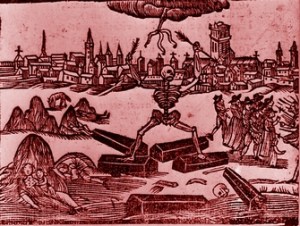 Late in January 1593, the Privy Council, worried about what looked like a new bout of plague, wrote a letter to London’s authorities, ordering to close all playhouses. It was one of many times this happened: City fathers, Privy Council, Puritans – a lot of people seemed ready to blame the playhouses for anything, from the corruption of minds, to general dishonesty and health troubles. Let us say that an attempt to contain contagion was one of the saner reasons for closing them down…
 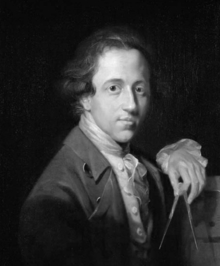 One particular discovery of this last trip to London was Sir John Soane’s museum house at Lincoln’s Inn Fields. I think I’d been there before, perhaps some twenty years ago, on my very first time in London – but, for some reason, the place had failed to strike me the way it has this time.
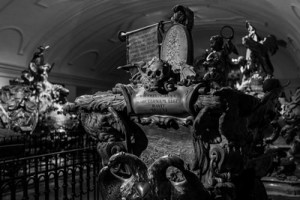 Vienna is, on many levels, a lovely city – but after reading Joseph Roth I was never able to see it in the same way again. Roth’s Empire, the one of the Hapsburgs, of the many ethnic groups, of my Dreiländer grandmother who gave her son an Emperor’s name, that elephantine, multilingual Empire, orderly in it chaos, austere, slow and immutable – that Empire died with Franz Josef, and decomposed with World War One. Most surely it is not to be found in the quaint patisseries in the form of the Sachertorten fed to endless tourists, nor in the ubiquitous Mozartkügeln, the girls dressed up as Sisi, the maudlin songs played in garden restaurants… Vienna has chosen a sugary image of the Empire, flattering for the national character and good for tourism – betraying the ancient, supranational and hallowed idea. Because while kingdoms are places, empires are ideas… Now a shadow of that idea only remains, perhaps, in the Kapuzinergruft in the Neue Markt.
 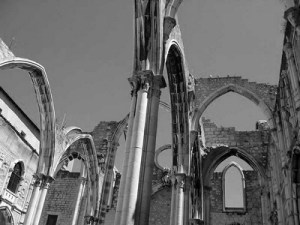 Lisbon, for instance, I found to be a strange place: melancholy, grand, and neglected, still dotted with ruins from the 1746 earthquake, with its tower overlooking the Tago, the cramped, untidy Alfama clinging around the crumbling castle, and caravels everywhere. Caravels are exhibited in museums, double as ex-votos in churches or children’s swings in parks, recur in trademarks and symbols everywhere… There is a sense of proud decay – as though the whole city whispered “let it all go to ruin, what matters now that the Empire is lost?
 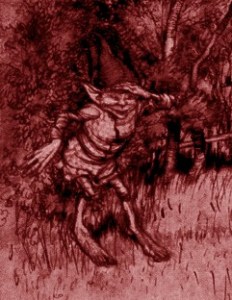 I’ve been meaning to write this post for some time now – and I mean quite some time. Last Spring, as I adapted Puck of Pook’s Hill for the stage and chose Rackham illustrations to make into scenery, and later, as I rehearsed the thing with my cherry-picked cast, and then as our Monday drew close – and later again, when all was done and gone well… Only, there was always something else to post about, or perhaps it was too soon, or… you know how it goes.
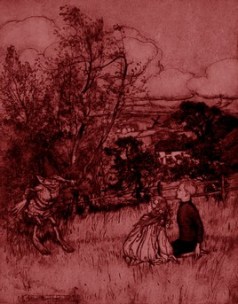 So, my own Lunedì is right behind the corner…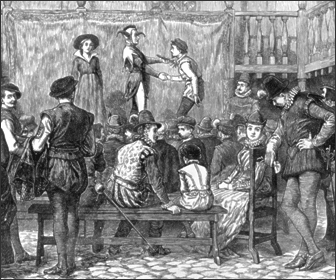
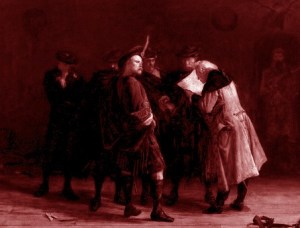 Obviously Scotland does this to me: it sends me on Jacobite tangents. Fictional tangents, mostly – because really, the moment you try a history book, the whole adventure loses much of its shine. Then again, seven decades of intermittent and unsuccessful attempts at restoring a royal line with the dubious aid of a foreign power were bound to be, on the one hand not terribly well organised, and on the other, perfect novel material… I mean: how can you have plenty of exiles headed by a handsome and charming prince, loyal clans, recurring bursts of violence, conspirations, secret messages, toasts to the King Across the Water, songs, divided families, spirited ladies, battles, and an ultimately doomed cause – and not expect an abundance of fiction? And of course, the foremost charm of the Jacobites is that of the doomed and defeated. Would we care very much about them, would we write novels, if they’d won?
  Scribblings