 Tonight.
Tonight is first night for Shakespeare in Words.
We’ll still squeeze in a scrap of tech rehearsal late this afternoon (or so I devoutly hope) and then… Continue reading

04 Thursday Aug 2016
Tonight.
Tonight is first night for Shakespeare in Words.
We’ll still squeeze in a scrap of tech rehearsal late this afternoon (or so I devoutly hope) and then… Continue reading
02 Tuesday Aug 2016
Posted in Things
 Ah, the joys and sorrows of research…
We all know how it goes. A story – be it a trilogy of door-stoppers, a play or a tiny short – is a world, and, to misquote Benedick, the world must be researched. And you can not find the stuff you need, or you can find too much and get lost in the meanders of it, or you can think you found the right stuff – and painfully discover later that you didn’t… Continue reading
30 Saturday Jul 2016
Tags
Albert Decaris, christopher marlowe, Heritage Press, illustration, Limited Edition Club, Saint Lucia, Tamburlaine the Great
 Dear Saint Lucia,
I’m not sure I’ve been good enough so far for this – but, were you by any chance wondering about what I might wish for December, here is an idea: I’ve discovered the existence of this lovely edition of four plays of Christopher Marlowe, published in the mid Sixties by Limited Edition Club and then Heritage Press, and illustrated by French artist Albert Decaris.
As you can see from the Tamburlaine here left, the illustrations are a wonder, and the whole book seems to have been conceived with much flair, design-wise… Continue reading
28 Thursday Jul 2016
Tags
Austin Phillips, Bryher, Elizabethan theatre, Jacobean Era, James Sands, The Player's Boy, Walter Raleigh
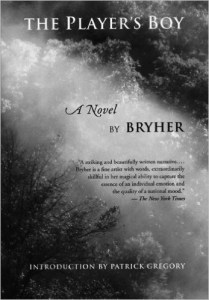 My acquaintance with Bryher‘s work is, I must say, limited to one book – but what a book!
The Player’s Boy tells the story of an apprentice who doesn’t become an actor in the early reign of James VI and I. Bryher had both a researcher’s interest and a passionate fondness for the golden era of Elizabethan theatre, and this novel tells it decline with a kind of haunting intenseness. Continue reading
26 Tuesday Jul 2016
 Last night, after rehearsals, it was far too hot to go home – and, the rehearsals having gone passably well, we weren’t in the mood to disperse yet anyway. So we sat, more or less in the dark, in the garden of our makeshift rehearsal room. We sat in a circle, and began to tell each other the combination of Sonnets 55 and 81 that ends the play.
We all said it in turn, the game being to do it as differently as we could from the person before us. Again and again we said it… Continue reading
23 Saturday Jul 2016
Posted in Things
 So it seems that Old English had about twenty different verbs for the act of sparkling/glittering:
ablican, ascimian, bliccettan, blyscan, brodian, brogdettan, glitenian, (ge)lixan, ræscan, ræscettan, scimian, scinefrian, spircan, tytan, scimian, blican, glisnian, spearcian, twinclian…
Say what you will, but I find there is something appealing in a language with so much sparkle to it…
And yes – I do love the Historical Thesaurus.
21 Thursday Jul 2016
Posted in Books
Tags
 Last night, over dinner, we discussed reading and re-reading. At one point I said that re-reading is the proof of how Knowing What Comes Next is not the key to the pleasure of reading. It sounded nice, and it worked well in the discussion, but the matter is less straightforward, I think – so here are a few thoughts.
First of all, we don’t all re-read. My father was one compulsive re-reader, and the books that were his show it with much wear and broken spines. My friend Clementina, on the other hand, never re-read a book in her life, because “once read, it’s read. What’s worth remembering I’ll remember, what I won’t remember isn’t worth it.” And they say that in his (admittedly brief) life, Vendean general Henri de la Rochejaquelein only read again and again the memoirs of I don’t remember what 17th century strategist. Perhaps he didn’t know Thomas Aquinas, who found the Man of One Book so unnerving…
Then, not all books are of the re-reading sort. This, again, varies hugely from person to person, but some books become members of the family, to which one returns again and again for comfort or guidance. Of the beauty of some other books, one never tires – each re-reading like that visit at the National Gallery whenever one is in London. Other books are tied to a moment, a memory, an atmosphere – and that’s what one seeks re-reading. Then there are those plots, or characters so perfect, one goes back to study how on earth the writer did it, and there are seasonal books that grow into yearly rituals, and favourite chapters, scenes and descriptions, and those books one read too early to truly appreciate them…
On the other hand, there are all the ugly, annoying, disappointing books, the ones we had to read or study, the ones that gave us nightmares, the ones too intense for comfort, the ones that came to highly recommended – or just the forgettable ones. The ones we’ll never want to re-read. 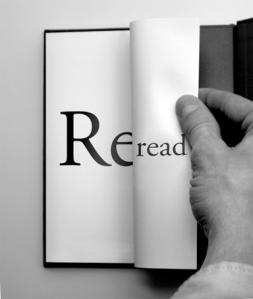
Whatever the reason, though, my theory is that reading and re-reading are to hugely different activities. A first reading is an exploration, a matter of thrills and surprises – a combination of the wish to know What Comes Next and the enjoyment of the way there. It’s a matter of discoveries, very much like meeting a person or visiting a place for the first time. It’s the kind of experience that, at its best, keeps on up at all hours of the night. It’s like a first love – and, once gone, it’s gone.
Re-reading, now… Ah, re-reading is another kettle of fish. One re-reads more analytically. One goes deeper. One savours, sifts, observes, peels layers and enjoys nuances and complexities. One knows the general lay of the land, and revisits leisurely, enjoying the familiarity and digging for new beauties. Much like renewing an acquaintance, or returning to a place. It has joys of its own – its own set of pleasures.
The snag is, of course, that reading-time is finite, and one either reads or re-reads… Which is, in the end, why I don’t re-read as much as I’d like. Still, my Reading Week is approaching (perhaps), and I have half a mind to make it a Re-Reading Week instead. Just this year…
We’ll see. But what about you, O Readers? Are you Re-Readers?
19 Tuesday Jul 2016
Tags
Brutus, communication, Erdogan, Julius Caesar, Mark Antony, military coup, theatre, Turkey, William Shakespeare
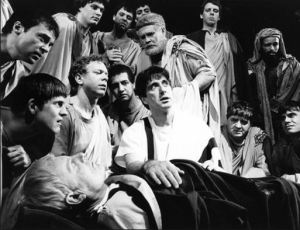 Saturday morning we were at rehearsals, Gemma and the Squirrels and I – with Turkey very much on everybody’s mind. We were going through Julius Caesar, Act III, Scene 2: Brutus and then Antony addressing the crowds. And as we worked our way through it, I had goosebumps and one of those small epiphanies: Shakespeare’s Rome and our Istanbul… Continue reading
16 Saturday Jul 2016
Tags
christopher marlowe, Open Source Shakespeare, searchable works, the Literature Network, William Shakespeare
 You know when you know there is that perfect bit in Shakespeare, that line about this or that? You know the speech you need is there, somewhere – but can’t exactly place it, let alone find it… Continue reading
14 Thursday Jul 2016
Posted in Theatre
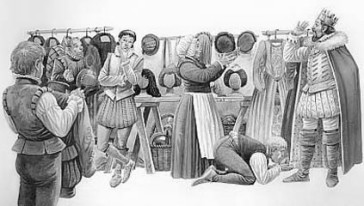 Remember the Squirrels, and Shakespeare in Words and everything? The last time I wrote about it all, I was soaring on the wings of enthusiasm….
Well, as I rather expected, we are now in the deepest gloom. Continue reading
 Scribblings