 Nothing very cheerful, to tell the truth – but then, I believe it is one of the thresholds to adulthood when Christmas Eve becomes a day of memories, absences and that kind of homesicknes that isn’t quite (or isn’t necessarily) for a place…
So we close the Kipling Year with this “Christmas in India”, so full of longing and homesickness, heavy with the memories of the English Christmas, the snow, the holly and the ivy… The worst time of the year, when one’s half a world away from home, is it?
Dim dawn behind the tamerisks — the sky is saffron-yellow —
As the women in the village grind the corn,
And the parrots seek the riverside, each calling to his fellow
That the Day, the staring Easter Day, is born.
O the white dust on the highway! O the stenches in the byway!
O the clammy fog that hovers over earth!
And at Home they’re making merry ‘neath the white and scarlet berry —
What part have India’s exiles in their mirth?
Full day begind the tamarisks — the sky is blue and staring —
As the cattle crawl afield beneath the yoke,
And they bear One o’er the field-path, who is past all hope or caring,
To the ghat below the curling wreaths of smoke.
Call on Rama, going slowly, as ye bear a brother lowly —
Call on Rama — he may hear, perhaps, your voice!
With our hymn-books and our psalters we appeal to other altars,
And to-day we bid “good Christian men rejoice!”
High noon behind the tamarisks — the sun is hot above us —
As at Home the Christmas Day is breaking wan.
They will drink our healths at dinner — those who tell us how they love us,
And forget us till another year be gone!
Oh the toil that knows no breaking! Oh the Heimweh, ceaseless, aching!
Oh the black dividing Sea and alien Plain!
Youth was cheap — wherefore we sold it.
Gold was good — we hoped to hold it,
And to-day we know the fulness of our gain!
Grey dusk behind the tamarisks — the parrots fly together —
As the sun is sinking slowly over Home;
And his last ray seems to mock us shackled in a lifelong tether.
That drags us back howe’er so far we roam.
Hard her service, poor her payment — she in ancient, tattered raiment —
India, she the grim Stepmother of our kind.
If a year of life be lent her, if her temple’s shrine we enter,
The door is shut — we may not look behind.
Black night behind the tamarisks — the owls begin their chorus —
As the conches from the temple scream and bray.
With the fruitless years behind us and the hopeless years before us,
Let us honor, O my brother, Christmas Day!
Call a truce, then, to our labours — let us feast with friends and neighbours,
And be merry as the custom of our caste;
For, if “faint and forced the laughter,” and if sadness follow after,
We are richer by one mocking Christmas past.
We have something like this in Italy too: Guido Gozzano, a young poet with weak lungs, spent a year traveling the East, in hope that a warmer climate would help him. It didn’t, in the long term – but this is why he spent Christmas 1912 in a solitary bungalow in Ceylon. A keen naturalist, poor Guido does his best to concentrate on the luxuriant beauty of his borrowed garden and the small kindnesses of his native servants, and not to think too much of home… until he hears the bells from the chapel across the valley, ringing for Christmas morning. And then the dam he so carefully built for himself breaks – because bells ring much the same at every latitude – and oh, how he would change all the queenly orchids in Ceylon for a glimpse of the snow and holly at home!
I’m sure he and Kipling would have had much to say to each other.
And, wherever you are – whether you are where you want to be or not – have a sweet Christmas Eve.

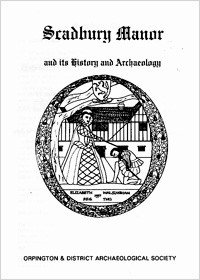 Remember when I said I hoped the will and funds could be found to preserve what remains of Thomas Walsingham’s Scadbury Manor in Kent?
 This is from the author’s introduction to
  In the end, my Christmas Reading Vacation (henceforth CRV), boiled down to one book – the first volume of
  I had an interesting discussion with a friend, a few days ago – about… well, about past and future.
 Because it’s New Year’s Eve, because I’m reading Scottish things and I’m in the mood, because I love this version arranged by Robert Shaw, because the end of December makes me maudlin beyond the telling, and just because.
 Celia Fiennes, with this lovely, novel-worthy name, was a remarkable Restoration lady.
 Scribblings