• The Tom Walsingham Mysteries
  • Clara who?
  • Stories
  • Contact

Scribblings

~ Clara Giuliani, storyteller

Scribblings

Category Archives: Stories

Happy Birthday, Shakespeare

24 Thursday Apr 2014

Posted by la Clarina in History, Lostintranslation, Stories, Theatre

≈ Leave a comment

Tags

#happybirthdayshakespeare, William Shakespeare

ShakespeareSo, this post is my answer to the Happy Birthday Shakespeare project, in which bloggers are invited to celebrate Will’s 450th birthday by posting about how his works impacted on their lives.

First things first, let me link to this thing I posted back in January, about my first Shakespeare ever. It is relevant to what I want to say. It tells how my very first Macbeth was an initiation. It was more than a little of a shock, too, and it marked eras in my perception of theatre: Before Macbeth, and After Macbeth.

And yet, it didn’t make me like it all of a sudden. It did not turn me into a rabid Shakespearian overnight. It didn’t even make me love English. That would be years later, and through another writer – who, ironically enough, hadn’t even been a native speaker. But it doesn’t matter now – or it only does in that my first impact with Shakespeare was through translations.

And my second, and third, and fourth…

It would be years before my English allowed me to appreciate Will’s works in the original, so I had to make do with translations, most of which were… well.

Let me state here that, much as I love to translate, my faith in literary translation is scant. Too many things are lost in the process, too many hues, and nuances, and shades, and implied meanings just cease to exist the moment you try to turn them into another language… And Shakespeare’s English, this rich, iridescent language that was incandescently moulding itself at the time, just has no equivalent in Italian.

I didn’t realise this back then, but the fact is, there are several Italian translations of Shakespeare’s works, often clever and accurate, I’m sure, but… but. I read them, I saw them played onstage, I liked the stories, but the translation was always there like a sheet of slightly opaque glass, dulling, dimming the experience.

Add to that the exasperating schoolbook habit of presenting any and every remarkable artist as a lonely star, shining and floating in a sort of vacuum…

So yes, I knew I should like Shakespeare, and indeed, did like his plays, but always had this disconcerting impression I should have liked him more. Somehow, I missed the vibrancy, and was left guessing at the power of the words.

Frustrating. Very much.

And then I learned English. I fell in love with the language, and never turned back. I started reading in English when I was eighteen, and within a few years I shyly tried my hand at Elizabethan English – both in reading and onstage – and found I loved it. It, and the time and place that had prompted this sort of language, this sort of theatre… History I’d always loved. Starting to read about Elizabethan England was a sort of homecoming. For some reason, I still cannot open a book – novel, essay, play – connected with Elizabeth’s time without feeling at home – and the more I read about the time, the life, the people, the more I understood and appreciated the plays.

So, no – it wasn’t perhaps love at first sight, but a love it was. A slow, long one, rooted in language and in history as much as in theatre, which is perhaps, in part, why it lasts the way it does.
 

The Tale of the Nail

17 Thursday Apr 2014

Posted by la Clarina in Stories

≈ 6 Comments

Covent Garden Market-675189. An oil painting showing the early morning bustle of Covent GardenEnglish is my second language, I love it madly – just as madly as I love English literature and history. I was lost to anglophilia at a very early age, I read in English more than I do in Italian, I spent years in several parts of the British Islands, and feel at home whenever I go back there.
That said, I maintain that, at times, the English could put a little more effort in an attempt to understand non-native speakers.
Let me tell you a small story.

I was once sitting with my mother at a very nice cafe in Covent Garden Piazza. We’d been trotting around London all day, so we were a tad out of breath and not a little thirsty.

When the waiter came to collect our orders, my mother, who used to speak a very good English but is now sadly out of practice and has been for some years, asked for “an ale.”

The waiter’s eyes went the size of saucers – and I sat back to enjoy the scene – which you might think not the nicest way to support one’s mother, but I can’t resist a good piece of nonsense when it happens. And indeed…
“A nail?” the waiter asked, in utter bemusement. “Whatever for, Madam?”

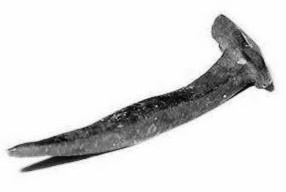
“What can I possibly want it for?” sweetly asked Mother, all oblivious. “To drink, you know.”Nails

And this is where I think the waiter could have made a little effort, because I know the grammar was off, but really – what could she be asking for?

Instead, he kept staring at Mother in rabbity fascination – and one could see the debate going on behind his eyes: shall I run for help or not? And Mother was staring back with raised eyebrows, and looked ready to get flustered, so I stepped in, and suggested that she might mean just “ale.”

The relief in the poor man’s eyes was a sight to see. Confident once again that the foreign lady wasn’t a a potentially dangerous, nail-drinking lunatic, he informed her that they were not licensed to sell alcoholic beverages at that time of the day, and could he get her something else instead?

At which point Mother grasped the whole ale/nail tangle, and had a fit of the giggles, and it fell to me to order grapefruit squashes to go with our sandwiches, and we acquired one of my favourite anedoctes ever.

Well, this was all of fifteen years ago, so perhaps things have changed since – but really: a a tad, a drop, a particle more effort?

Enhanced by Zemanta

Macbeth Blues ♫

05 Saturday Apr 2014

Posted by la Clarina in Stories

≈ 1 Comment

Tags

Billie Holiday, Blues, Leonard Bernstein, macbeth, shakespeare

Behold a young Leonard Bernstein matching Billie Holiday with Shakespeare… who knew that Blues was iambic pentameter set to music!

https://www.youtube.com/watch?v=u1Wm9ugJ8qQ

Oh, I’m in love with this…

Playing With History

13 Thursday Mar 2014

Posted by la Clarina in Books, History, Stories

≈ 2 Comments

Tags

christopher marlowe, Historical fiction, History Play, Rodney Bolt

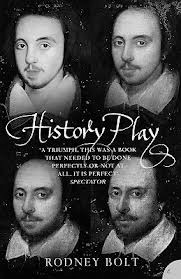
HPBWIf I were to tell how I became a Marlowe enthusiast – and I’m not speaking too hypothetically, either: I was asked yesterday – I should go back to when I read, over one day and one night, Rodney Bolt’s History Play.

How I came across the book at all, I don’t remember – it’s been quite a few years, but come across it I did, and bought it from Amazon. I had already a taste for all things Elizabethan, back then, and was reading like mad about the period, and Shakespeare, and his fellow poets, but knew next to nothing about the authorship question.

In hindsight, it is strange that, up to that point, I knew so little about Marlowe, and stranger still that, of all the books about him, I should pick just this one.  But I did, and I remember, on a summer afternoon, sitting in a marginally cooler spot on a marble staircase, putting aside the dustjacket, and plunging. And it was… odd.

It started off as an especially antistratfordian life of Marlowe, a very well-written and rather convincing one, too. And then… then it oh so subtly veered into academic parody, and then less subtly, and by the time I realized half the footnotes were fabrications, and half the sources made up, the thing had metamorphed again to alternate history novel, and I was not only hooked, but delighted at the clever trick that had been played on me.

Because this book was not what it seemed at a first glance, and then not even what it seemed at a second, and all the time played fast and loose with historical accuracy in a very clever way, showing how both history and fiction could be manipulated to look like the other, and shaped, and mingled, and combined, and masked – and it all came complete with gorgeous writing, a neatly twisted plot and great characters, especially Kit Marlowe.

Indeed, I might even say that Marlowe was almost a collateral effect, because after fully enjoying the game, I wanted to know what kind of rings exactly had been danced around my suspension of disbelief. So I started on a reading spree: Marlowe’s works – of which there isn’t an awful lot – and a deluge of biographies, articles, essays. And I fell in love – enough that, in time, I crossed the border into fiction, novels and plays about Marlowe, and I started writing about him, and he is still my current obsession.

So, isn’t serendipity wonderful, that made me buy this book so filled with ideas about history and fiction, and find a new obsession in the bargain? You never know what you might find between the covers of a book.

Related articles
  • Happy 450th birthday to William Shakespeare and Christopher Marlowe (theguardian.com)
Enhanced by Zemanta

Glenn Gould On Writing (Fugues)

01 Saturday Mar 2014

Posted by la Clarina in Stories

≈ Leave a comment

Tags

Glenn Gould, so you want to write a fugue, writing

No, not really – but this is the incredible So You Want To Write A Fugue (thanks M. for telling me about it!) and I can’t help thinking how well it applies to non-musical writing…

So you want to write a fugue.
You got the urge to write a fugue.
You got the nerve to write a fugue.
So go ahead, so go ahead and write a fugue.
Go ahead and write a fugue that we can sing.

Pay no heed, Pay no mind.
Pay no heed to what we tell you,
Pay no mind to what we tell you.
Cast away all that you were told
And the theory that you read.
As we said come and write one,
Oh do come and write one,
Write a fugue that we can sing.

Now the only way to write one
Is to plunge right in and write one.
Just forget the rules and write one,
Just ignore the rules and try.

And the fun of it will get you.
And the joy of it will fetch you.
Its a pleasure that is bound to satisfy.
When you decide that John Sebastian must have been a very personable guy.

Never be clever
for the sake of being clever,
for the sake of showing off.

For a canon in inversion is a dangerous diversion,
And a bit of augmentation is a serious temptation,
While a stretto diminution is an obvious allusion.

For to try to write a fugue that we can sing.

And when you finish writing it
I think you will find a great joy in it.

or so…
Nothing ventured, nothing gained they say
But still it is rather hard to start.

Well let us try right now.
Now we are going to write a fugue.
We are going to write a good one.
We are going to write a fugue … right now.

Oh, and a happy March, everyone.

The God Abandons Anthony

15 Saturday Feb 2014

Posted by la Clarina in Stories

≈ 2 Comments

Tags

Constantine P. Cavafy, Edmund Keeley, Ellen Kushner, Philip Sherrard, Poetry

Deutsch: Kavafis 1929 in seiner Wohnung in Ale...Poetry today.

You know those times, when you come across a piece of poetry that will make you shiver with the depth and beauty and unexpectedness it employs to express something that is achingly familiar…

Well, it happened with this poem of Constantine Cavafy (here in a translation by Edmund Keeley and Philip Sherrard – that I found thanks to Ellen Kushner.

When suddenly, at midnight, you hear
an invisible procession going by
with exquisite music, voices,
don’t mourn your luck that’s failing now,
work gone wrong, your plans
all proving deceptive—don’t mourn them uselessly.
As one long prepared, and graced with courage,
say goodbye to her, the Alexandria that is leaving.
Above all, don’t fool yourself, don’t say
it was a dream, your ears deceived you:
don’t degrade yourself with empty hopes like these.
As one long prepared, and graced with courage,
as is right for you who proved worthy of this kind of city,
go firmly to the window
and listen with deep emotion, but not
with the whining, the pleas of a coward;
listen—your final delectation—to the voices,
to the exquisite music of that strange procession,
and say goodbye to her, to the Alexandria you are losing.

Acknowledging defeat – in the form of a metaphysical procession in the middle of the night… ah. Beautiful. Haunting. Shiver-provoking. Didn’t you shiver?

Related articles
  • On Cavafy’s Side (3quarksdaily.com)
  • CP Cavafy: The Complete Poems – review (guardian.co.uk)
  • Cavafy translations (readysteadybook.com)
Enhanced by Zemanta

Overdoing Chekhov’s Gun

13 Thursday Feb 2014

Posted by la Clarina in Stories

≈ Leave a comment

Tags

Chekhov's gun

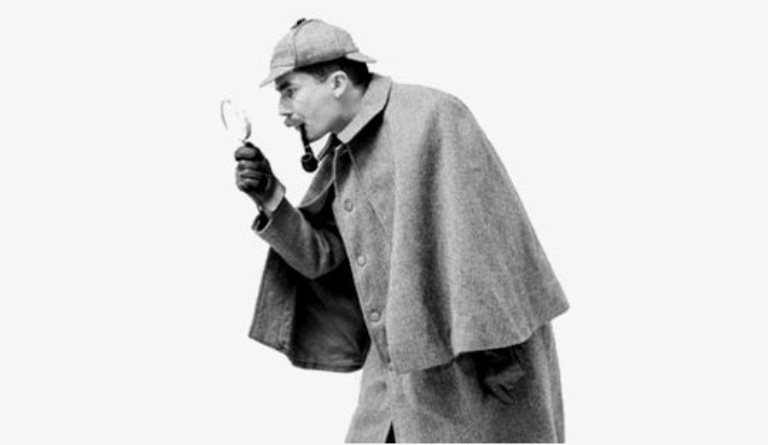
sherlock_holmes_in_public-domainP. cannot believe I enjoy anything I read or watch. Books, movies, tv series – all is ruined, P. says, by my tendency to over-analyze. He told me so one night, as we ate a very late dinner and half-heartedly watched some procedural or other.

At one point someone, little more and an extra up until then, asked a question about the murder, and one of the main characters answered.“Hm…” I murmured, with a spoonful of soup stopped midair. “See that fellow? He’s got Chekhov’s Gun.”

“He’s got what?” asked P.

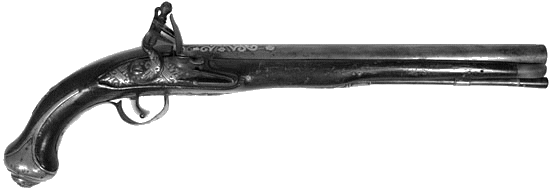
Now, Chekov’s Gun is anything that is introduced early in the narration, and in a casual manner – for its relevance to become apparent in the dénouement. When it is well done, the thing may lead to one of those happy moments when readers/viewers slap their foreheads and chuckle to themselves, amused at how well they’ve been led around.

In this specific case, it was done a tad conspicuously – or so it seemed to me…

“Chekhov’s Gun,” I explained. “Well, Chekhov’s Question, but still. Want to wager he’s the culprit?”

“Hmf,” said P.69_murashev_pistol

And in the end, the murderer turned out to be Chekhov’s Gunman indeed.“See?” I gloated shamelessly.P. was not pleased.“Had you seen it before?” he asked.“Of course not, but you could tell. He had too much dialogue for the sort of character he was… It’s like… You know, in the book you borrowed, when the heroine meets Tr… ”And here P. told me to shut my mouth. He didn’t want to know. He was still reading the book, and I had already spoiled the procedural for him…“Tell me this, though: the heroine meets Tr. on… what? Page 12? Does this mean that at page 12 you already knew how it would end?”“Well… no. But I knew whodunit. He had Chekhov’s Gun, you see…”Which is why, according to P., I cannot possibly enjoy what I read and watch. Too bloody busy prodding and poking structure, and writing, and characterization, and historical accuracy… How can I read, with all the din of my cogs and wheels turning?Trouble is, P. is simultaneously right and wrong. Because I enjoy immensely taking apart my toys to see how they work – but I must must must remember that not everybody does.Not everybody reads – or watches – the way a writer does.

Related articles
  • Self-Editing Tip #19 – Chekhov’s Gun (marsicowritesite.wordpress.com)
  • Utilize Chekhov’s gun to make plot work (inventingrealityeditingservice.typepad.com)
Enhanced by Zemanta

Barber’s Marlowe

18 Saturday Jan 2014

Posted by la Clarina in Books, History, Stories

≈ 2 Comments

Tags

christopher marlowe, Ros Barber, The Marlowe Papers, William Shakespeare

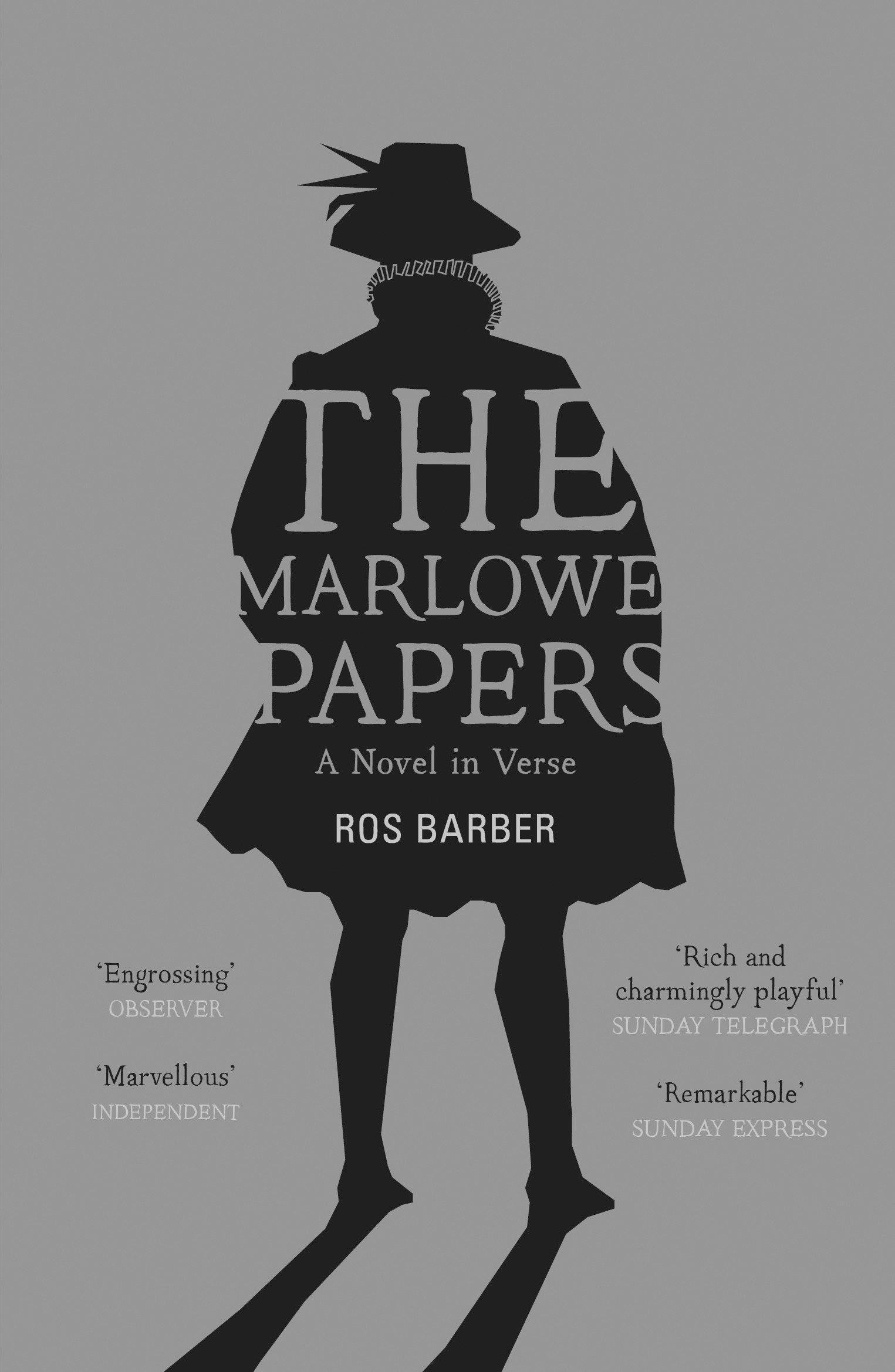
The-Marlowe-Papers-pb-jacketBWI dithered long enough before committing to read Ros Barber‘s The Marlowe Papers.

I’m no neo-Marlovian, no anti-Stratfordian – and this promised to be yet another tale of how Kit Marlowe didn’t die in Deptford, but lived to write Shakespeare’s canon… honestly, just how done is that? And yes, there was the intriguing notion of a novel in blank iambic pentameters – but was it enough to tempt me?

As I dithered, Santa Claus acted, and I found The MP under my Christmas tree, and since it was there, I decided I could have a look at it… and was entirely hooked by page three.

Because Ms. Barber takes the old tale and tells it in a fresh and imaginative and compelling way. And mind – the freshness doesn’t lie so much in the way she nicely weaves together known facts, gaps in knowledge, and wild speculation. She does it well, but others have done it before. What makes this book a delight is the first person narrator – Marlowe himself, of course, recounting his glories and misfortunes in verse for (perhaps) Thomas Walsingham.

We root for him as he more or less glibly walks to his ruin, short scene by short scene, in a whirl of arrogance, fiery genius, naivety, misplaced trust, longing, and doomed hopes. And goodness – it is gripping. All the more so for the restless, urgent pulse that Kit’s voice finds in the rhythm of the blank verse.

And yes – Ros Barber managed to sell me a tale I don’t much care for, by telling it so grippingly that I just forget what it is all about. I stop thinking of the slightly preposterous premise, and let myself be swept away by the story itself, its hero’s voice… Sheer word-magic. Can one ask more of a novel?

Enhanced by Zemanta

Rite of passage

04 Saturday Jan 2014

Posted by la Clarina in Stories, Theatre

≈ Leave a comment

Tags

macbeth, shakespeare, teatro romano, theatre, verona, words

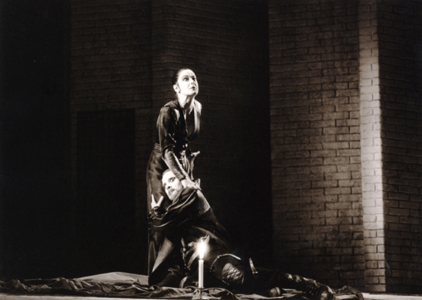
Summer night, warm and damp to the point of stickiness. The lights are doused, and the chattering dies down to a trail of whispers. For a handful of moments, I can hear the crickets in the trees all around the theatre. One of those handfuls of moments calculated to break just when the audience has forgotten to breath – but I’m just eleven, and innocent of this kind of calculations.

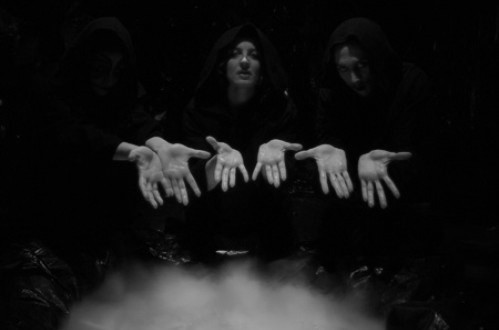
macbeth-499x330Suddenly comes a shaft of purplish light, then follows the bang of a trapdoor opening – then the witches climb onstage in a whorl of black rags and cackles, and run to crouch around the cauldron…

“Way to start,” mutters A., in the next seat. And although she is thirteen and bewildered, she is right. Far more than she knows.

I am eleven, as I said, and this is my first Macbeth. My first Shakespeare. My first time at the Teatro Romano in Verona. My first less than traditional production. I know who Shakespeare is, but I never saw anything of his staged. As far as staged things go, my experience boils down to some children’s plays and a few nights at the opera – very traditional-minded productions. I’m not prepared for a tale of Medieval kings in Scotland changed – no, distilled to an affair of empty stage, shadows, cutting lights and nondescript, black costumes.

I’m not even sure I like it all that much. Why, truth be told, I’m rather disappointed. Everything is so grim, so dark, no tartan sashes, no cloaks, no swords, no crenellated towers, nothing of what I had expected…1987-macbeth

And then, little by little, with no bells and whistles to keep my attention, I start to concentrate on the words. Not just the plot, but the way the words make the plot different from its synopsis. Yes, yes, the witches, the prophecy, the regicide, the folly, the defeat – it’s all there. But the creeping fear and guilt, the hoot of the night birds, the ghost, the blood stains that won’t go away, the boughs from Birnam Wood closing in… it all takes life from the power of the words, in a way no painted scenery, no elaborate costume could ever convey. And not just life, but truth.

And mind you, when we file out of the theatre I’m still eleven, and not entirely convinced of what I saw. I still much prefer crenellated towers and period costumes, and I secretly hope all theatre needn’t be like tonight, thank you very much. And yet, when Father asks did I like the Macbeth, I say yes, and it’s not a complete lie. I may not have liked it in the usal sense of the word, but I know I’ve gone through some rite of passage. A door has opened on something that I don’t fully understand yet, but looks meaningful. Something that has to do not only with tales, but the way tales are told. Something that I want to understand – and learn, if I can.

More than twenty-five years later, I know that what Shakespeare taught me that night was the power of words. A similar production of a weaker play would have just bored me to tears, but because Shakespeare’s words were so powerful, the young girl I was grasped the essence of the story – and something else too: a hazy notion that, while the production and the acting were modern interpretation, through the words the long dead Shakespeare was still speaking to me across the centuries.

It was very hazy back then, I grant you, but it was to grow, branch out, develop into several tenets of my faith in words, when it comes to history, literature, and writing. Not bad for one shakespearean night, was it?

And… Fourteen!

01 Wednesday Jan 2014

Posted by la Clarina in Stories

≈ 1 Comment

Tags

new year

8d187f4d137f87632591bc6e038244bfI wish you all, o Readers, a wonderful 2014, full of writing, ideas, discoveries, good chances, good books, good friends – or let’s not be too specific: I wish you a new year to match your notion of happiness!

← Older posts
Newer posts →

Seek and Find

♠ THE TOM WALSINGHAM MYSTERIES

Available on Amazon
Available on Amazon

The Copperfield Review’s first anthology – containing Gentleman in Velvet

Recent Posts

  • For Queen and Country: Tom Walsingham at the HNR
  • A Snare of Deceit is out!
  • A Deadly Complot
  • Merry Christmas!
  • Death in Rheims – Publication day!

Popular Scribblings

  • Noises Off: a crash course in backstage mayhem
  • Antonia Forest: The other Player's Boy
  • Dickens for (Italian) Children
  • Dante's Ulysses
  • Kickstarting Kidnapped
  • Music in a different language?

Categories

  • Books
  • Eccentricities
  • History
  • Lostintranslation
  • Poetry
  • Scribbling
  • Silents
  • Stories
  • Theatre
  • Things
  • Uncategorized

Enter your email address to get a messenger on horseback... er, an email will reach you by email when a new Scribbling is out.

Join 311 other subscribers

RSS Feeds

  • RSS - Posts
  • RSS - Comments

No Blog’s an Island

Sapere Books


IBA

International Bloggers' Association

I tweet on Twitter

And I pin on Pinterest

Senza Errori di Stumpa – my Italian blog

Blog at WordPress.com.

Privacy & Cookies: This site uses cookies. By continuing to use this website, you agree to their use.
To find out more, including how to control cookies, see here: Cookie Policy
  • Subscribe Subscribed
    • Scribblings
    • Join 311 other subscribers
    • Already have a WordPress.com account? Log in now.
    • Scribblings
    • Subscribe Subscribed
    • Sign up
    • Log in
    • Report this content
    • View site in Reader
    • Manage subscriptions
    • Collapse this bar
 

Loading Comments...