• The Tom Walsingham Mysteries
  • Clara who?
  • Stories
  • Contact

Scribblings

~ Clara Giuliani, storyteller

Scribblings

Tag Archives: shakespeare

Five Characters For A (Wild) Night Out

06 Thursday Mar 2014

Posted by la Clarina in Books

≈ 5 Comments

Tags

Anthony Burgess, christopher marlowe, Connie Willis, Georgette Heyer, meme, shakespeare, Stevenson
stepping_out_of_bookThere was this meme, once upon a time… Suppose it turns out you can summon characters out of books.  And frankly, if I could summon characters out of books, I’d do it all the time, and spend inordinate amounts of time with them… er, yes – I’m that far gone. But for the moment, let us stick with the meme: which five characters would I want as company for a wild night out?

Well, I was reminded of this meme when my friend G. told me about a wonderful RPG she plays at college, involving randomly assigned literary characters. On being reminded, I sought and found the answer I wrote, once upon a time, on my Italian blog, and realised that, if I were to do it again, I’d choose different characters – at least most of them. After all, one wild night is one wild night, and a girl doesn’t have to want to hang out with the same crowd forever, right?

So, considering that my notion of a wild night, out or otherwise, includes (but is not limited to) endless and occasionally argumentative talk on a variety of subjects, impromptu theatre games, nonsense galore, and a certain quantity of eccentric mischief, here is my round of invitations:book-characters-coming-to-life-as-boy-reads-bmp2
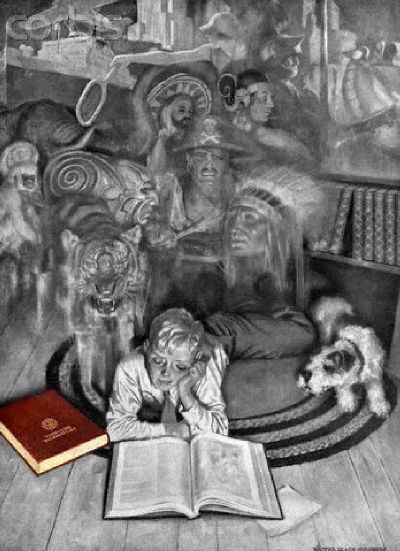
1) Beatrice, from Much Ado About Nothing. Unbeatable at wordplay without being too waspish. Merry, witty company – and she sings too.

2) Sarah Thane, from Georgette Heyer‘s The Talisman Ring. A woman with a taste for absurdity and the right turn of phrase – and a prodigious liar when the occasion requires it. I’m sure we’ll go along very, very well.

3) Kit Marlowe – Anthony Burgess‘ version – strikes me as the sort who can be relied upon for vertiginous conversation about almost anything. And all the theatre one could wish for. The trick will be to keep him from becoming nasty when in his cups.

4) Alan Breck Stewart. A man with a dancing madness in his eyes, who can improvise extempore ballads at the least provocation sounds far too perfect to leave out. He has enough of a temper to cause trouble, and of course Scotland, England and Scotland and England as conversation topics are out of the question, but I’ll be careful.

5) Ned Henry, Connie Willis‘ historian-cum-time-traveller. He can be a tad scatterbrained, especially when time-lagged, but adorably so – and he is one of the nicest imaginary persons I know. Plus, he is a time traveller, and really, nothing would make my wild night like some time travel .

Well well well, considering that my first choices were Nicholas Christopher‘s Veronica, Emily Brontë*, Puck, Sidney Carton and Kit Marlowe, I’d say that this time I’ve equipped myself for a far jollier wild night, wouldn’t you?

And what about you? Which five characters would you invite out of books for a wild night?

_____________________________________

* Yes, I was cheating. You could say I cheated again with Marlowe, but I mean Marlowe-as-a-character. Or else I just cheat at memes, so sue me.

Enhanced by Zemanta

Rite of passage

04 Saturday Jan 2014

Posted by la Clarina in Stories, Theatre

≈ Leave a comment

Tags

macbeth, shakespeare, teatro romano, theatre, verona, words

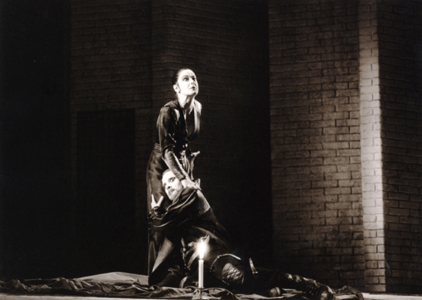
Summer night, warm and damp to the point of stickiness. The lights are doused, and the chattering dies down to a trail of whispers. For a handful of moments, I can hear the crickets in the trees all around the theatre. One of those handfuls of moments calculated to break just when the audience has forgotten to breath – but I’m just eleven, and innocent of this kind of calculations.

macbeth-499x330Suddenly comes a shaft of purplish light, then follows the bang of a trapdoor opening – then the witches climb onstage in a whorl of black rags and cackles, and run to crouch around the cauldron…

“Way to start,” mutters A., in the next seat. And although she is thirteen and bewildered, she is right. Far more than she knows.

I am eleven, as I said, and this is my first Macbeth. My first Shakespeare. My first time at the Teatro Romano in Verona. My first less than traditional production. I know who Shakespeare is, but I never saw anything of his staged. As far as staged things go, my experience boils down to some children’s plays and a few nights at the opera – very traditional-minded productions. I’m not prepared for a tale of Medieval kings in Scotland changed – no, distilled to an affair of empty stage, shadows, cutting lights and nondescript, black costumes.

I’m not even sure I like it all that much. Why, truth be told, I’m rather disappointed. Everything is so grim, so dark, no tartan sashes, no cloaks, no swords, no crenellated towers, nothing of what I had expected…1987-macbeth

And then, little by little, with no bells and whistles to keep my attention, I start to concentrate on the words. Not just the plot, but the way the words make the plot different from its synopsis. Yes, yes, the witches, the prophecy, the regicide, the folly, the defeat – it’s all there. But the creeping fear and guilt, the hoot of the night birds, the ghost, the blood stains that won’t go away, the boughs from Birnam Wood closing in… it all takes life from the power of the words, in a way no painted scenery, no elaborate costume could ever convey. And not just life, but truth.

And mind you, when we file out of the theatre I’m still eleven, and not entirely convinced of what I saw. I still much prefer crenellated towers and period costumes, and I secretly hope all theatre needn’t be like tonight, thank you very much. And yet, when Father asks did I like the Macbeth, I say yes, and it’s not a complete lie. I may not have liked it in the usal sense of the word, but I know I’ve gone through some rite of passage. A door has opened on something that I don’t fully understand yet, but looks meaningful. Something that has to do not only with tales, but the way tales are told. Something that I want to understand – and learn, if I can.

More than twenty-five years later, I know that what Shakespeare taught me that night was the power of words. A similar production of a weaker play would have just bored me to tears, but because Shakespeare’s words were so powerful, the young girl I was grasped the essence of the story – and something else too: a hazy notion that, while the production and the acting were modern interpretation, through the words the long dead Shakespeare was still speaking to me across the centuries.

It was very hazy back then, I grant you, but it was to grow, branch out, develop into several tenets of my faith in words, when it comes to history, literature, and writing. Not bad for one shakespearean night, was it?

What’s In A Name

21 Saturday Dec 2013

Posted by la Clarina in Scribbling

≈ Leave a comment

Tags

character naming, revision, shakespeare

NamesI beg to differ from the Bard on this: I’m not all that sure a rose would smell as sweet if it were called, say, benzopyrene. Or, even if it did, would you really smell it to make sure?

Names matter. Names are not all the same.

And yes, I confess: I’m the sort who will stay after the film is ended, to read the names in the end credits. The sort who will sift through obituaries, other people’s old class lists and spam mail for names. The sort who, when playing D&D at sixteen, could agonize for weeks over the name of a Level 1 elf…

When I start writing something new, names are all important. I can spend hours poring over name lists in dictionaries, seeking The Right Name. And it’s hardly ever a matter of meaning. Mostly, it’s the sound. And of course, when writing historicals, other considerations weight in the choice, such as time period, custom and social suitability – but all the same, the name must sound right for the character.

Oddly enough, I don’t always choose first names I like. I’ve foisted on beloved characters names I’d frankly hate to bear, while some names I love never proved right for any character of mine. Odder still, last names work differently:  they must not only sound well with the character’s first name – for some reason, I want to like them.

All this to say that there is this novel I’m slowly revising, in which two main characters bore names starting with A, and three different beta readers suggested that I should change at least one. It seems it’s not a good idea to have different characters’ name begin with the same letter. Readers might get confused.

Yes, yes – I know: I think I’d take offence too if anyone implied that I can mix up two very different characters just because they share an initial. And yet… what if someone got confused? What if they had to check again and again to make sure who’s who? What if they threw the book away before page thirty – because they can’t tell characters apart? Not good, is it?

So in the end I decided to give up one of my oh-so-carefully chose names, and I’m not enormously happy, because one I like, and the other is perfect for the character, and no amount of list sifting has yet produced a good alternative for either…

And no: my characters don’t smell as sweet by any other name. Why, one of them has even changed face in my mind – all because of the name I’m not sure I’ll keep… I dare say that, for once and as far as I’m concerned, Shakespeare just might be wrong.


Related articles
  • Naming Characters… and why I’d be a bad parent (rickywilkswriting.wordpress.com)

Sonnets in Progress

05 Saturday Oct 2013

Posted by la Clarina in Theatre

≈ Leave a comment

Tags

shakespeare, sonnets, theatre

ShakespeareSo, there is this theatre company based in my hometown of Mantova. They are seriously good. I’ve been working with them for the last three years. They’ve staged a handful of one-act plays of mine – and I love them.

When it happened first, it was a dream

come true. My wonderful Grandmamma used to take me to their Sunday matinées when I was a child, and I sat in their small theatre, lost to wonder and enchantment, and I wanted to play that game too.

It was because of this company that at ten, if asked what I wanted to be when I grew up, I would answer “a playwright.” It got me a few raised eyebrows – which was fun in itself.

So you see – when they first staged me, it was really a dream come true.

And now, they’ve commissioned me a stage adaptation of Shakespeare’s Sonnets for 2014.

No, of course it’s not “now”. It was done early, and with time to spare, so that “now” I am finished with the second draft, and next week I’m going to start a thorough editing, and then I’ll hand in the play for workshopping…

I’m not unhappy with what I have done. I’m incredibly excited about the whole thing. I can’t wait for them to start work on my Sonnets.

Who knows where this will lead in the scheme of one’s hopes and ambitions – not to mention the general scheme of things. But for now, I certainly am the playwright my ten-year-old self dreamt I’d become.

Not bad, for now.

Related articles
  • Shakespeare’s Sonnets (nwanuch.wordpress.com)
  • Examining Shakespeare’s Sonnets 9-18-13 (jstotz1331.wordpress.com)

Shakespeare – The Hidden Truth

07 Saturday Sep 2013

Posted by la Clarina in History

≈ Leave a comment

Tags

authorship question, first folio, francis bacon, petter amundsen, shakespeare

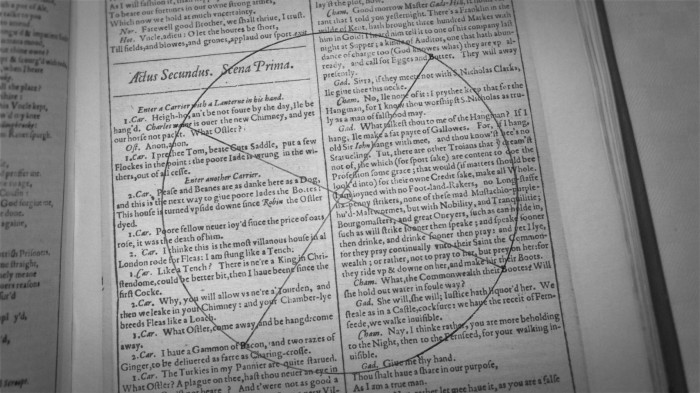
FirstFolioSo, Petter Amundsen is this Norwegian organist, freemason,”dabbler in occultism”, and steganographer, who claims he found evidence that Sir Francis Bacon wrote Shakespeare’s plays – and found it in the First Folio.

He’s not the first. Delia Bacon started that back in 1857, based on a combination of “discovered” cipher and quasi-mystical hunches*, and hordes of cryptographers have pursued her trail ever since, “uncovering” all sorts of hidden messages in Shakespeare’s works.

Usually, the Bacon side of the Authorship Question lithobrakes against little facts such as the huge difference between Bacon’s own style and Shakespeare’s, or Bacon’s life – a very busy one without throwing in some forty plays…

Amundsen sidesteps these objections by saying that why, yes – but then, who wrote Shakespeare is not the real question…

And this, you’ll agree, is… well, unusual. Then again, Amundsen is not so much an anti-Stratfordian as a conspiracy theorist. He claims that, whoever wrote Shakespeare, did so to forward the Rosicrucian goal of a “universal reform of Mankind”. And who was the leader of the very, very secret order of the Rosy Cross – so very secret that its very existence is none too sure? But Francis Bacon, of course! Anyway, in 1623, whoever was behind the publication of the First Folio (and Bacon just happened to be a master steganographer…) had a number of clues encripted in the printed text – clues leading to the treasure buried on Oak Island, off the coast of Nova Scotia.

What treasure? The lost menorah from the temple of Jerusalem, and Shakespeare’s original manuscripts – preserved in quicksilver.

Shakespeare – The Hidden Truth is a documentary movie telling the tale of Amundsen’s research in company with an English PhD student – and ortodox Stratfordian – who starts ofs as a sceptic and ends up… with doubts. And it is a nice, well made, exciting movie, and it shows a huge quantity of coincidences, but…

But, even discounting my own penchant towards Stratfordian ortodoxy, I can’t help wondering: whoever wrote Shakespeare**, how would he (or they) know what to write so that the right letters and words would combine into the required symbols and clues right on the various pages 53 in the printed version, decades later?

You could say they didn’t, and tweaked the text in 1623. Right – and Amundsen shows some instance of what could look like tampering with page numbers. But I suspect that something more would be needed to achieve all those triangles, constellations and acrostycs… So, how about the Quartos? Does a check against these much earlier editions show enough tweaking in the relevant parts of the First Folio to support Amundsen’s theory?

Still, my biggest doubt remains: why?

According to Amundsen, the original manuscripts are hidden underground, somewhere on Oak Island, preserved in quicksilver for eternity – but why?

Supposing Francis Bacon and his nephew, on behalf of the order of the Rosy Cross, wrote or commissioned Shakespeare’s plays, and hid there the key to the treasure hunt, why go to all this trouble?

Why bother to hide half a world away something whose importance actually resides in the printed version? That is, if the menorah is the prize – and we must assume so, because frankly, Shakespeare’s manuscripts may be the holy grail of literature to us, but  back then, they were just Shakespeare’s manuscripts.

No, really. I doubt anyone, in Elizabethan or Jacobean times, thought of theatre in terms of eternity… Plays were written and consumed fast, publication (and in folio!) was the high mark of success, theatre was hardly what a poet wanted – or expected – to be remembered for.

The notion sounds distinctly anachronistic. But then, it also sounds very much like a locked case containing its own key, doesn’t it?

So yes, I’ll admit coincidence seems to be there in abundant quantity – but then, when you look for coincidence, you usually find it – and all the rest apart, I remain with eyebrows raised, and a lot of questions unanswered.

____________________________________________

* When she crossed the Pond, she famously perplexed her British supporters by all but refusing to see any Shakespearean or Baconian documents. She preferred, she said, to imbibe the atmosphere by taking strolls in what she thought to be the right places…

** And Amundsen seems to allow the chance that Shakespeare wrote his own plays, after all – but at the behest of Sir Francis Bacon.

Newer posts →

Seek and Find

♠ THE TOM WALSINGHAM MYSTERIES

Available on Amazon
Available on Amazon

The Copperfield Review’s first anthology – containing Gentleman in Velvet

Recent Posts

  • For Queen and Country: Tom Walsingham at the HNR
  • A Snare of Deceit is out!
  • A Deadly Complot
  • Merry Christmas!
  • Death in Rheims – Publication day!

Popular Scribblings

  • A wee bit of magic
  • Noises Off: a crash course in backstage mayhem
  • If I taught history...
  • Tableaux Vivants
  • Silent Film School
  • Bad King John

Categories

  • Books
  • Eccentricities
  • History
  • Lostintranslation
  • Poetry
  • Scribbling
  • Silents
  • Stories
  • Theatre
  • Things
  • Uncategorized

Enter your email address to get a messenger on horseback... er, an email will reach you by email when a new Scribbling is out.

Join 311 other subscribers

RSS Feeds

  • RSS - Posts
  • RSS - Comments

No Blog’s an Island

Sapere Books


IBA

International Bloggers' Association

I tweet on Twitter

And I pin on Pinterest

Senza Errori di Stumpa – my Italian blog

Create a free website or blog at WordPress.com.

Privacy & Cookies: This site uses cookies. By continuing to use this website, you agree to their use.
To find out more, including how to control cookies, see here: Cookie Policy
  • Subscribe Subscribed
    • Scribblings
    • Join 311 other subscribers
    • Already have a WordPress.com account? Log in now.
    • Scribblings
    • Subscribe Subscribed
    • Sign up
    • Log in
    • Report this content
    • View site in Reader
    • Manage subscriptions
    • Collapse this bar
 

Loading Comments...