 This post is part of the Swashathon!, “a wild and adventurous event featuring the finest swashbucklers in the history of cinema”, hosted by Fritzi Kramer’s wonderful Movies Silently to celebrate the movie début of Douglas Fairbanks – right 100 years ago.
Shall we begin?
Young Rupert, who looked a dare-devil, and could not have been more than twenty-two or twenty-three, took the lead, and made us the neatest speech, wherein my devoted subject and loving brother Michael of Strelsau, prayed me to pardon him for not paying his addresses in person, and, further, for not putting his Castle at my disposal; the reason for both of these apparent derelictions being that he and several of his servants lay sick of scarlet fever, and were in a very sad, and also a very infectious state. So declared young Rupert with an insolent smile on his curling upper lip and a toss of his thick hair—he was a handsome villain, and the gossip ran that many a lady had troubled her heart for him already.
Thus enter stage Rupert of Hentzau, in Chapter Twelve of Anthony Hope’s The Prisoner Of Zenda – after which he walks away with the book and never returns it. Why, the sequel is even called “Rupert of Hentzau”…
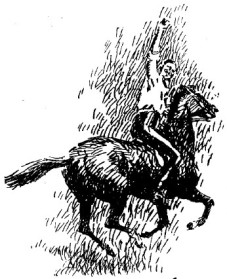 It is a pet theory of mine that Hope’s intentions for Rupert may have gone a bit overboard. Unlike the hero Rudolf Rassendyll and his Ruritanian friends, the boy does not behave as a gentleman should – but, unlike them, he is certainly never boring. Charming, reckless, and with the moral compass of a coat-hanger, Rupert is easily the best character in the book- and in the sequel as well. While both narrators (Rassendlyll himself and his friend Fritz) take pains to inform us that he is a cheat, a liar, a womanizer and a murderer, that his wicked ways have broken his poor mother’s heart, and that he is evil in every possible way, they also spend a lot of words rhapsodising over young Rupert’s cleverness, charm, reckless bravery, beauty, superior horsemanship & swordmanship… Why, even his enemies can’t help liking the young rogue.
It follows that, when bringing this story and its sequel to the screen, the casting of Rupert is a rather crucial choice. Between 1913 and 1964 he was played by Walter Hale, Gerald Ames, Ramon Novarro, Douglas Fairbanks, Jr. and James Mason, Farley Granger and Peter Wyngarde – but since all the silent versions before 1922 are either lost or buried in the Library of Congress, and old TV series are not terribly easy to come by, I’ll have to confine myself to only three Ruperts.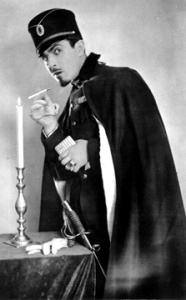
Let’s begin with Ramon Novarro in the 1922 Ingram version. Novarro is 23 – just the right age – and one gets the sense that his Rupert, with his monocle, goatee, walking stick, cigarettes, and dandyish ways, is trying to appear older. He manages to look older and more sophisticated than Fritz von Tarlenheim – but often young Hentzau comes across as a mischievous boy masquerading to fit in a world of older men. Then again, the masquerade is far from innocent, and Novarro’s Rupert likes his mischief to be of the lethal variety. He smirks, he blows clouds of smoke, he quizzes duller people (that is, everyone else) through his monocle, he cocks an eyebrow to the camera, he delivers drugged wine, he knifes obnoxious princes in the ribs – all with a nice air of urbane and amused arrogance. This Rupert clearly enjoys himself a good deal.
There is nothing to clash with the man in the book. Ingram, Mary O’Hara and Novarro get Rupert nearly right. Nearly- but nearly, as Rassendyll tells Rupert during the duel in the last chapter of the sequel, isn’t quite.
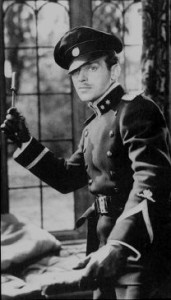 Fast forward fifteen years, then, to John Cromwell’s 1937 The Prisoner of Zenda, with 28-year-old Douglas Fairbanks, Jr. as Rupert. A tighter script helps, but Fairbanks is truly wonderful. His Rupert is a charming, devil-may-care young fellow with a ready laugh and a readier knife – and he is quite mad. Under the smooth insolence and the sunny smiles, this Rupert is dangerous. And yet one can’t help liking him as he cheerfully betrays whomever happens to be in the way, manipulates enemies and friends, duels with great flair and resents Rassendyll’s slights… For my money, this is Rupert of Hentzau.
What about James Mason, then? Alas… Let me say 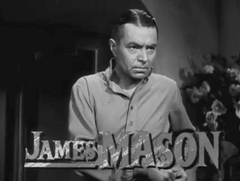 first that I like James Mason – but I’m afraid Rupert was not his cup of tea. All else apart, in 1952 he was 44 – twice the character’s age – and looked older. Too old, too staid, and far too grim. Oh, he is intense, he is dangerous – but where is the boyish, laughing charm? Where is the mad light in the eyes? Mason’s Rupert plots and threatens with the general allure of a Prussian junker… How can we believe that his enemies like him despite themselves? The fact that the movie is an almost scene-by-scene remake of the 1937 version doesn’t help, either. I remember once discussing this movie with a friend, and trying to decide what other actor might have made a better Rupert in 1952… You know, we drew a blank – and I still cannot think of anyone*, but this doesn’t make me like Mason better in the role, although I’ll admit it was hard to measure up to Douglas Fairbanks.
So, to recap, Novarro provides the charm, but not enough threat, while Mason delivers the wrong sort of charm-less menace – but Fairbanks is quite perfect: charming, boyish, dangerous, mad. The Rupert. So very perfect, in fact, that I have to end on a note of regret: producer David O. Selznick meant to go ahead, and make “Rupert of Hentzau” as well, with the same cast, but the idea was later discarded. Isn’t it a pity that we’ll never see Doug duel and grin his way through the rest of Rupert’s story?
And don’t forget to visit the Swashathon! page on Movies Silently, to find links to the other great entries.
_________________________________
* Can you? I’m curious…

 Right now, I think that all you can find in English is the Author’s Note, explaining what and why. Amongst other things, you’ll find that Swiss film historian Dumont quotes Stanley Kubrick’s notion that “one of the things the cinema knows how to do better than any of the other arts, is to bring to the screen historical subjects.” Continue reading
  So, this is my contribution to
  I had an interesting discussion with a friend, a few days ago – about… well, about past and future.
 Almost exactly two-hundred and four years ago,
 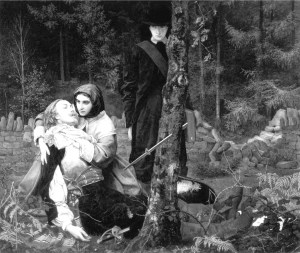 For some reason, The Hessian Renegades put me in mind of William Shakespeare Burton’s The Wounded Cavalier.
 Last week I watched Elizabeth for the first time – and was more than a little bewildered by the script.
 said Winston Churchill… and write it he did. Authors of historical fiction usually go about “writing history” with more modest ambitions – or do they? Just look at Walter Scott or Charles Dickens… And I know Dickens was no historical novelist, properly speaking, but there is no denying that A Tale of Two Cities did much to shape the common perception of the French Revolution…
 d History Will Be Kind, The Copperfield Review’s first anthology, provides an interesting exercise in “telling history”. A rich collection of historical short stories, poems and essays, it explores a range of historical periods, characters and events – from Empress Maud to Alexander the Great, from the Third Crusade to 1914 Mexico – and Kit Marlowe, of course. My own very young Kit Marlowe who, in Gentleman in Velvet, learns a hard lesson about consequences and prices to be paid.
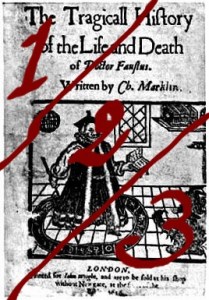 One thing that we noticed while reading Faustus with the Paper Stage, was that perhaps a three-part reading doesn’t suit every play – and this is true of the 1616 B Text of Faustus.
 Scribblings