• The Tom Walsingham Mysteries
  • Clara who?
  • Stories
  • Contact

Scribblings

~ Clara Giuliani, storyteller

Scribblings

Category Archives: Theatre

The Wicked Stage

15 Saturday Mar 2014

Posted by la Clarina in Theatre

≈ Leave a comment

Tags

New York Times, Rob Weinert-Kendt, theatre

The day my plays cross the Pond…

Yes, well, it’s still rather far away, right now, but a girl can dream big while she is at it, can’t she?

So, the day my plays cross the Pond, I hope that Rob Weinert-Kendt will review them. Which is dreaming even bigger, because RWK writes for the American Theater Magazine and the New York Times amongst many others, but…

It’s a wish I conceived a few years ago, when I came across his review of I don’t remember what production of Hamlet – and it was so deep, and perceptive, and wonderfully written, that I wished someone would write like that about a play of mine, someday…

As I said, that is far, far, far away in the future – at the very best. Meanwhile, one can read Mr. Weinert-Kendt’s great theatre blog, The Wicked Stage – which is what this little Saturday post is about, in the end.

Enhanced by Zemanta

Penny Plain, Twopence Coloured

22 Saturday Feb 2014

Posted by la Clarina in Theatre

≈ 2 Comments

Tags

Lucia Contreras, Pollock, R. L. Stevenson, toy theatre, Victoria and Albert

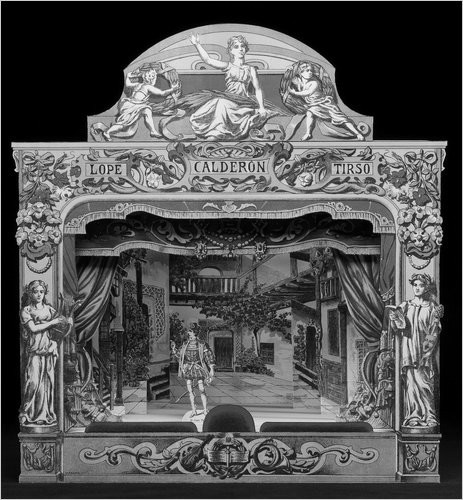
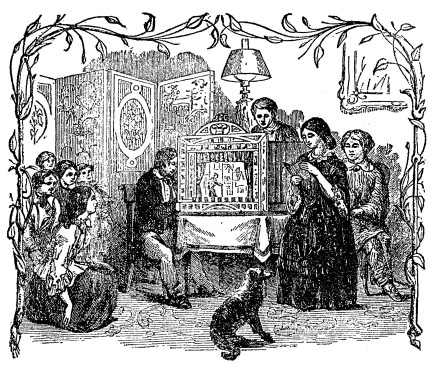
Spanish Theater from the Bruce Museum in Greenwich Conn - A child's veiwI’m in a toy-theatre phase.

I go through this sort of things, and right now it’s toy theatres. Let me get my printer working again, and chances are I’ll make myself one in the weekend. Actually, last Saint Lucia I was given a lovely, Pollock-bought one, to cut and assemble, but it is so intricate I’m a litte in awe. It will take some guts just to start cutting. Meanwhile, I might try something easier…

But never mind. For now I thought I’d share a few TT-related links.

Here you can find R.L. Stevenson’s delightful essay from which I borrowed this post’s title. And of course, Pollock’s. Then there is Lucia Contreras’ site Teatritos, where you can read about paper theatres and view images from her wonderful collection. Should you have developed an urge to have a toy theatre of your own, here the V&A provides you with all the printables you need – including a play. And last, possibly the one reason why I might wish for an iPad: a TT app!

And have a nice theatrical weekend.

Related articles
  • Visit to Pollocks Toy Museum (emmaharry92.wordpress.com)
Enhanced by Zemanta

The hunt for “Queen of Scots”.

08 Saturday Feb 2014

Posted by la Clarina in Books, Theatre

≈ Leave a comment

Tags

Bodleian Libraries, Gordon Daviot, Gwen ffrangcon-Davies, John Gielgud, Josephine Tey, Laurence Olivier, Queen of Scots

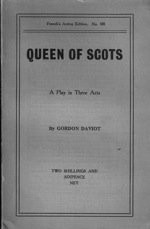
jtI’ve been wanting to read Josephine Tey/Gordon Daviot’s Queen of Scots for ages, and never could – the only way, when you live in Italy, being to buy some insanely expensive old edition.

But I like Tey/Daviot’s plays, and I’ve loved her Dickon and her Richard of Bordeaux. It’s old-fashioned historical theatre the way I like it, the sort of plays that makes me wish I’d been there, in the West End, in the Thirties, when QoS premiered starring Gwen ffrangcon-Davies and Laurence Olivier, under the direction of John Gielgud.

So, as a last attempt before splurging, I decided to try for an international inter-library loan. I did my research, filled my form, and went to the library in town. The lady who presides over this kind of loans was sympathethic but not overly sanguine. British libraries, she said, are wary of entrusting their books to the Italian mail service – and small blame to them…21HI3cR5WtL

So, imagine my surprise when next day Ms. R. phoned to say she had my play – in pdf format. Only, it was rather bulky. Did I mind bringing a memory stick or something?

I didn’t mind, of course, and I am now the proud owner of a pdf of a 1934 Gollancz edition from the Bodleian Libraries – no less – which I will happily read over the weekend. Or more likely tonight.

And Ms. R. is an angel, and I love her dearly, and libraries are wonderful institutions, and how would we live without the net – and we all lived happily ever after.

Related articles
  • Mary, Queen of Scots (edartfest2013.wordpress.com)
  • Actors on Actors Who Act Shakespeare (nytimes.com)
Enhanced by Zemanta

Black, Red, White, Yellow

01 Saturday Feb 2014

Posted by la Clarina in Theatre

≈ Leave a comment

Tags

christopher marlowe, Color blindness, Tamburlaine, Una Ellis-Fermor

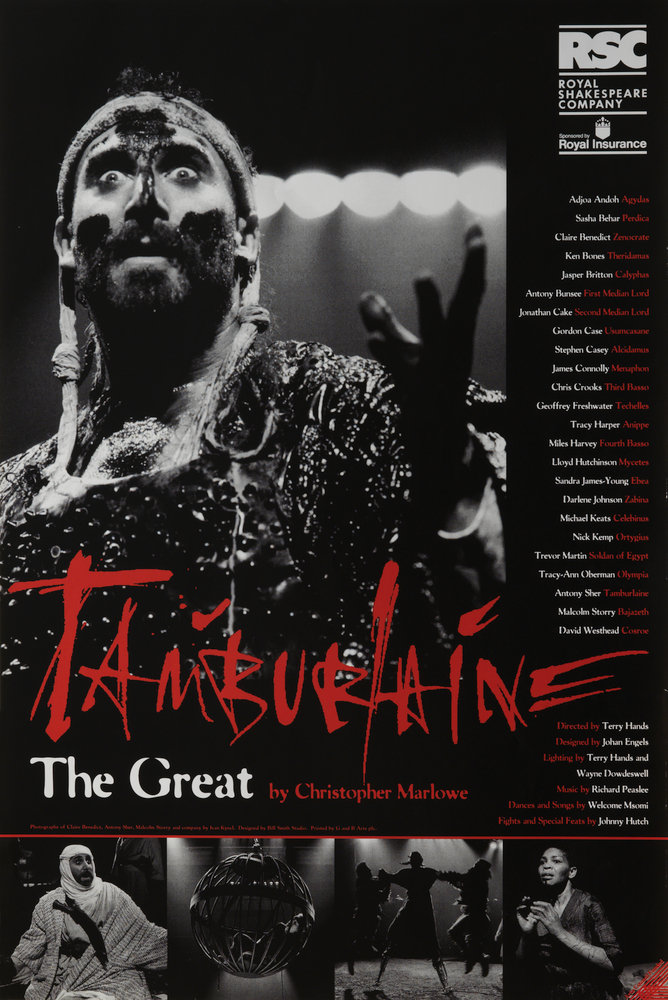
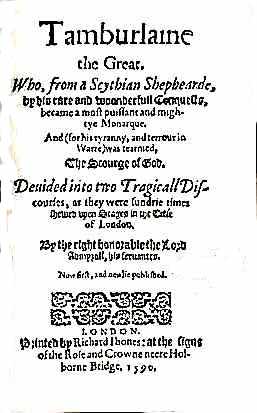
job_0375In her biography of Christopher Marlowe, Una Ellis-Fermor says there are no other colours in all of Tamburlaine the Great, except white, red, black, and yellow.

And of course, one thinks immediately of the siege of Damascus, and the tents going from white, to red, to black to show the decreasing leniency of Tamburlaine’s peace terms… And then, banners of white, red and black, and yellow sands, and lakes of black pitch, and blood in Elizabethan abundance, and gold, and snowy hills, and sunlight, and jet, and white horses… Apart from one single mention of sapphires*, in Tamburlaine “there is nothing to show that Marlowe wasn’t colour-blind to everything but red and yellow.” But of course, it was not a case of selective colour-blindness, it was a very conscious choice.

Now, to write a whole tragedy within such a narrow colour palette takes guts. It’s not just a matter of not naming unwanted colours: one must be very careful in the choice of imagery. Too much emphasis on the grass or the sky, and up pop unintended greens and blues, and the colour scheme is wrecked… But Kit Marlowe was a genius, ignored the meaning of the word “modesty”, and at twenty-three had mastered his technique. Not yet his dramatic technique, perhaps, but as for poetry… White, black, yellow, red – and nothing else. T2

Ellis-Fermor’s colour-scheme seems to have fascinated directors, as the hastiest research on Google Images shows, and I can easily see why. Even discounting as sheer chance the copper-coloured lace on the doublet of Ned Alleyn‘s first Tamburlaine in 1587, the notion of staging a play with a colour palette that is reflected in the text is mouth-watering…

Ah well, I doubt I’ll ever have a chance to direct Tamburlaine, but one thing I might try. In writing. I might choose three of four colours, and keep to them for description, imagery, figures of speech… And yes – I had better try it on a short story or a short play…

A really short one.

_____________________________________________

* Ellis-Fermor says he may actually have meant diamonds – but after all, even Kit Marlowe could slip once in a tragedy, couldn’t he? Or his publishers could…

Enhanced by Zemanta

Discovering Baroque in Hackney

29 Wednesday Jan 2014

Posted by la Clarina in Books, Theatre

≈ Leave a comment

Tags

George Dillon, Katy Evans-Bush, London, Ros Barber

Not Saturday, I know, but I just happened on this review of Ros Barber’s The Marlowe Papers – remember? – on Baroque in Hackney, poet Katy Evans-Bush’s lovely blog of “poetry, arts and culture”, and that led to this other review of George Dillon’s The Man Who Was Hamlet.

And it all made me remember how much I miss London.

And I thought I’d let you know, both about the review and the blog…

Enhanced by Zemanta

Rite of passage

04 Saturday Jan 2014

Posted by la Clarina in Stories, Theatre

≈ Leave a comment

Tags

macbeth, shakespeare, teatro romano, theatre, verona, words

Summer night, warm and damp to the point of stickiness. The lights are doused, and the chattering dies down to a trail of whispers. For a handful of moments, I can hear the crickets in the trees all around the theatre. One of those handfuls of moments calculated to break just when the audience has forgotten to breath – but I’m just eleven, and innocent of this kind of calculations.

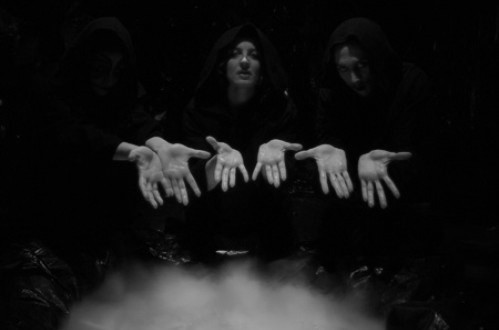
macbeth-499x330Suddenly comes a shaft of purplish light, then follows the bang of a trapdoor opening – then the witches climb onstage in a whorl of black rags and cackles, and run to crouch around the cauldron…

“Way to start,” mutters A., in the next seat. And although she is thirteen and bewildered, she is right. Far more than she knows.

I am eleven, as I said, and this is my first Macbeth. My first Shakespeare. My first time at the Teatro Romano in Verona. My first less than traditional production. I know who Shakespeare is, but I never saw anything of his staged. As far as staged things go, my experience boils down to some children’s plays and a few nights at the opera – very traditional-minded productions. I’m not prepared for a tale of Medieval kings in Scotland changed – no, distilled to an affair of empty stage, shadows, cutting lights and nondescript, black costumes.

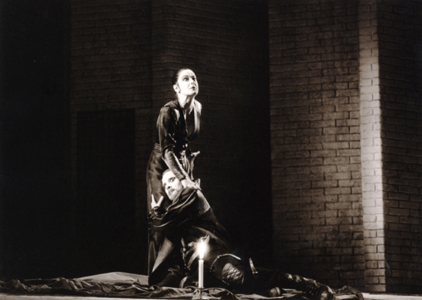
I’m not even sure I like it all that much. Why, truth be told, I’m rather disappointed. Everything is so grim, so dark, no tartan sashes, no cloaks, no swords, no crenellated towers, nothing of what I had expected…1987-macbeth
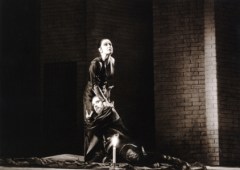
And then, little by little, with no bells and whistles to keep my attention, I start to concentrate on the words. Not just the plot, but the way the words make the plot different from its synopsis. Yes, yes, the witches, the prophecy, the regicide, the folly, the defeat – it’s all there. But the creeping fear and guilt, the hoot of the night birds, the ghost, the blood stains that won’t go away, the boughs from Birnam Wood closing in… it all takes life from the power of the words, in a way no painted scenery, no elaborate costume could ever convey. And not just life, but truth.

And mind you, when we file out of the theatre I’m still eleven, and not entirely convinced of what I saw. I still much prefer crenellated towers and period costumes, and I secretly hope all theatre needn’t be like tonight, thank you very much. And yet, when Father asks did I like the Macbeth, I say yes, and it’s not a complete lie. I may not have liked it in the usal sense of the word, but I know I’ve gone through some rite of passage. A door has opened on something that I don’t fully understand yet, but looks meaningful. Something that has to do not only with tales, but the way tales are told. Something that I want to understand – and learn, if I can.

More than twenty-five years later, I know that what Shakespeare taught me that night was the power of words. A similar production of a weaker play would have just bored me to tears, but because Shakespeare’s words were so powerful, the young girl I was grasped the essence of the story – and something else too: a hazy notion that, while the production and the acting were modern interpretation, through the words the long dead Shakespeare was still speaking to me across the centuries.

It was very hazy back then, I grant you, but it was to grow, branch out, develop into several tenets of my faith in words, when it comes to history, literature, and writing. Not bad for one shakespearean night, was it?

New Year Approaching Fast

28 Saturday Dec 2013

Posted by la Clarina in History, Theatre

≈ 1 Comment

Tags

authorship question, christopher marlowe, Elizabethan era, William Henry Ireland, William Shakespeare

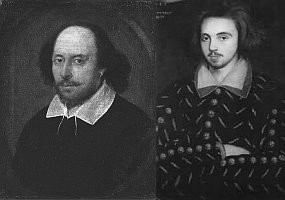
ShakespeareMarloweDid you notice? The Shakespeare Year is right around the corner.

Shakespeare & Marlowe Year – thank you very much, because let us not forget those two were born a few months apart. A good harvest when it came to playwrights, 1564 was…

And I’m getting ready. This will be an intensely Elizabethan year for me. I’m going to blog about it – so be warned: lots of Shakespeare and Marlowe to come.

And then there are, if all goes well, the Sonnets play, and a few others I have in various stages of readiness – including a radio drama – and another I want to write.

And a school project involving A Midsummer Night’s Dream.

And the lectures. I’ve sent and I’m still sending around to libraries, reading groups, schools and everyone I can think of that might even remotely be interested – offering my… shall we call it my array* of lectures on Shakespeare, Marlowe, Elizabethan England, Authorship Question, William Henry Ireland, Sonnets, espionage, School of the Night, whatnot…

So yes – as I said, this is going to be an intensely Elizabethan year. And believe me: you are going to hear about it.

__________________________________________

* Yes, we shall: I love the word.

Related articles
  • ‘Suit the Action to the Word’ (nytimes.com)
  • Shakespeare In Love, The Perfect Gateway to Shakespeare’s Biography (digitalcrowsnest.wordpress.com)
  • Marlowe and The Mighty Line (uofuhistoryoftheatre.wordpress.com)

Image

Ink & Saltwater

18 Monday Nov 2013

Tags

emilio salgari, john masefield, joseph conrad

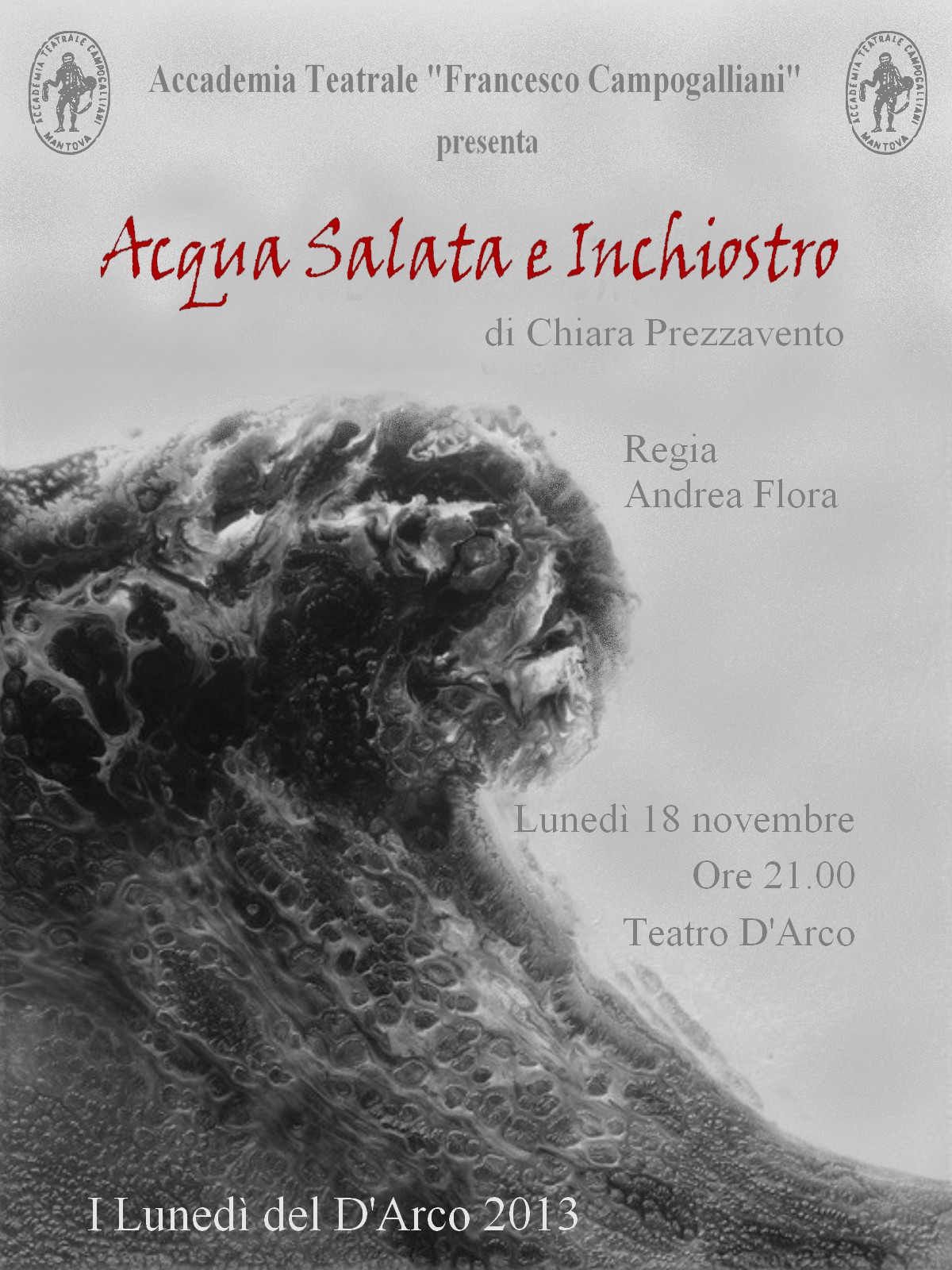
Here we go. My Conrad thing goes onstage tonight, and I’m all aflutter and ajitter…

18Novembrebn

And here‘s a link to the Pinterest Board I made for this project…

Wish me luck.

Posted by la Clarina | Filed under Theatre

≈ 1 Comment

Emma, Kit and I

16 Saturday Nov 2013

Posted by la Clarina in History, Stories, Theatre

≈ Leave a comment

Tags

#StoryMOOC, christopher marlowe, Questia Online Library, Richard Horne

I told you about the MOOC on the future of storytelling, didn’t I?

Last week’s creative challenge was to make up a character, and give him or her an online life. So Emma was born, and she has a blog, where she babbles about her obsession for Christopher Marlowe…

English: American poet and playwright Josephin...Amongst other things, she’s posted about Jospehine Preston Peabody’s play – the one I mentioned here. So I thought I’d make use of her post to explain things a little.

I first came across this play on Questia, of all places, and I love it: it is a quaint affair in blank verse, with perhaps the most likeable fictional Kit I ever found. JPP is unashamedly in love with her hero – and yet, she doesn’t make him too annoyingly perfect. All right, it could be argued that he is a rather idealized Marlowe, but bear in mind the play was written long before most of what are now key Marlowe documents were dug out. So Aunt Josephine writes a fiery, moody, aspiring young man, a victim of his own rashness and far-flung notions, as much as of jealousy, meanness and intrigue – and leaves out most of what is unpleasant and/or controversial.

But, for once, never mind historical accuracy: her Kit is likeable, and as he very much dominates the scene, this is more than enough for me.

I’ll say it again: I love this play. It is the sort of thing you’d stage with old-fashioned costumes, painted scenery, honey-thick
toy-theatre-in-a-victorian-parlor1lighting… There is a game I like to play when I surf the Net, singling out bits of scenery, props and stuff I’d use for my imaginary production – and who knows, maybe some day I’ll make myself a JPP toy-theatre.

Besides, last night, while looking up a picture for Emma’s post I found two Marlowe-themed plays I’d never heard about. Nineteenth Centrury stuff, in resounding blank verse, from what I gather: Richard Horne‘s The Death of Marlowe, and James Dryden Hosken’s Christopher Marlowe.

So, isn’t it wonderful? Emma is three days old, has a few friends, writes posts I can use as inspiration, and finds long-forgotten plays I’ll like to read… I am so glad I made her up!

Related articles
  • Festival brings Christopher Marlowe back to centre stage (thetimes.co.uk)
  • Christopher Marlowe (uofuhistoryoftheatre.wordpress.com)

The Tale of the Hostile Reviewer

19 Saturday Oct 2013

Posted by la Clarina in Theatre

≈ 3 Comments

Tags

Bertrand Russell, joseph conrad, reviews, theatre

English: Joseph Conrad

I didn’t see it happen – I wasn’t there – but the scene was described to me in loving detail.

He is a movie and theatre critic for the local press, with a handful of books published with a variety of houses, and one staged play to his name. Let us call him Mr. C.

She is a very good director I know and work with. We’ll call her Nina.

One day Mr. C. approaches Nina and tells her he is writing a play about Joseph Conrad.

“Are you?” says Nina, whose company is currently rehearsing a play of mine about Joseph Conrad.

Mr. C. proceeds to explain how he means to stage a very philosophical dialogue between Conrad and Bertrand Russell. The two shared a very deep friendship, does Nina know, and so he conceives this one-act play with just two characters…

It hardly looks like my (already finished, mind) play could be construed as plagiarism by any stretch of the imagination, but the man isn’t known for his equanimity. Anxious to avoid future complications, Nina jumps in.

“What a coincidence!” she chirps at her most cheerful. “Clara just wrote us a play about Conrad. Clara Giuliani, you know her.”

Mr. C. chews the notion the way he would a green lemon. He does know me – and is not amused. He twists his mouth this way and that for a while, and then…

“Did she now,” he says. “I think I might give her some advice.”

“Oh, but the play is finished.” Nina shows him my title on the season’s poster. “Actually, we started rehearsals in Semptember.”

“Ah.” Mr. C. has grown icy. He glares at my title. “Very well,” he says. “Reserve a seat for me, will you?”

And, Nina says, he has this look, you know. The look of one who is going to shred my play to ribbons in print – just on principle.

Oh, pittikins.

First night still four weeks away, and I have a hostile review already. Ain’t it just great?

← Older posts
Newer posts →

Seek and Find

♠ THE TOM WALSINGHAM MYSTERIES

Available on Amazon
Available on Amazon

The Copperfield Review’s first anthology – containing Gentleman in Velvet

Recent Posts

  • For Queen and Country: Tom Walsingham at the HNR
  • A Snare of Deceit is out!
  • A Deadly Complot
  • Merry Christmas!
  • Death in Rheims – Publication day!

Popular Scribblings

  • Dante's Ulysses
  • Truth & Reality
  • Mapping Metaphors
  • Shakespeare in Words - the war bulletin
  • Dante's Manfred
  • The Tale of the Nail

Categories

  • Books
  • Eccentricities
  • History
  • Lostintranslation
  • Poetry
  • Scribbling
  • Silents
  • Stories
  • Theatre
  • Things
  • Uncategorized

Enter your email address to get a messenger on horseback... er, an email will reach you by email when a new Scribbling is out.

Join 311 other subscribers

RSS Feeds

  • RSS - Posts
  • RSS - Comments

No Blog’s an Island

Sapere Books


IBA

International Bloggers' Association

I tweet on Twitter

And I pin on Pinterest

Senza Errori di Stumpa – my Italian blog

Create a free website or blog at WordPress.com.

Privacy & Cookies: This site uses cookies. By continuing to use this website, you agree to their use.
To find out more, including how to control cookies, see here: Cookie Policy
  • Subscribe Subscribed
    • Scribblings
    • Join 311 other subscribers
    • Already have a WordPress.com account? Log in now.
    • Scribblings
    • Subscribe Subscribed
    • Sign up
    • Log in
    • Report this content
    • View site in Reader
    • Manage subscriptions
    • Collapse this bar
 

Loading Comments...