But what’s a Faustus?

Tags

, ,

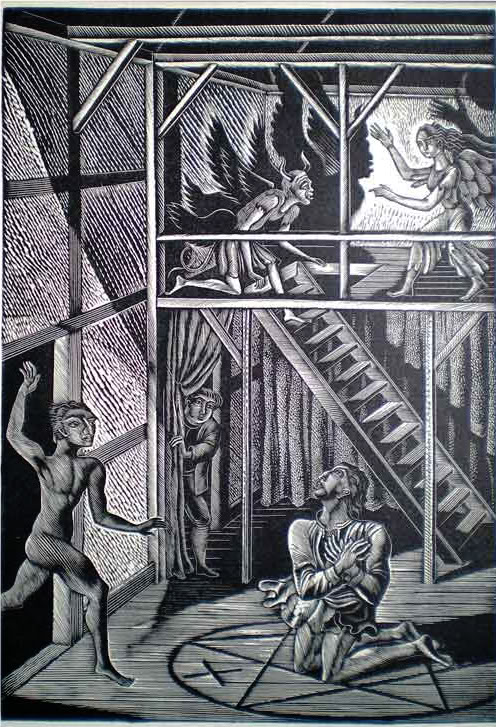
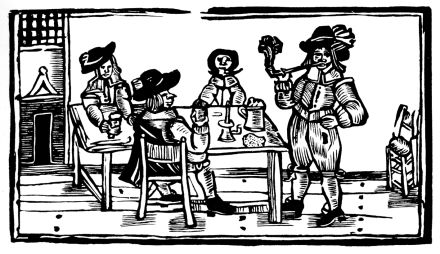
tavern_scene_woodcut1At the beginning of Josephine Preston Peabody’s quaint verse play Marlowe there’s this little scene, in which two groundlings walk in a tavern. One of them comes from the playhouse, where he just saw the new play, Faustus, and is full of the wonders of it.

Little he knows that the young men egging him on are the Wits – poets, playwrights, and friends to the author of Faustus… Continue reading

The Actor’s Dilemma

Tags

, , , ,

ActorOne of the actors taking part in the Palcoscenico di Carta/Paper Stage project made a very interesting observation.

It all began with a night-time message after the first of three meetings, in which he had read Faust(us) himself.

“This is a little awkward,” he wrote. “I’d like to be told I was good, but I don’t think I was… There’s no time, no room to work on the character – and I see that the PS calls for a reading, rather than a deeper identification… This is how it is, but still I feel inadequate. My fault, for never knowing how to keep to the golden mean.” Continue reading

The Parson and Napoleon

Tags

, , ,

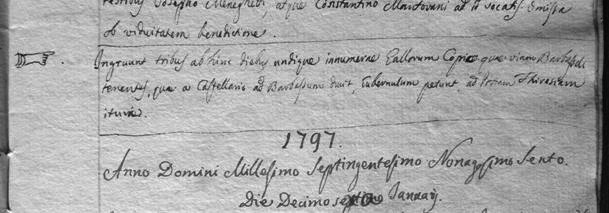
Some years ago I had the chance to peruse some late XVIIIth century registers from a local parish. I was looking for first-hand information about the passage of Napoleon’s troops in my corner of the world between 1796 and 1797, and while most parsons ran away when the French arrived, I eventually found trace of one who didn’t. Napoleonici

Don Francesco Doni not only remained in his parish, but also added “current affairs” annotations in his parish books, between recordings of births, marriages and deaths… Continue reading

Virtual Rose

Tags

, , , , ,

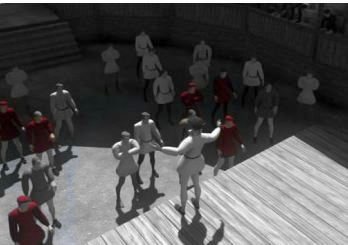
virtual RoseWho knew? Ortelia.com, specialising in “interactive environments”, among other things made a virtual model of the Rose Playhouse in Bankside – Philip Henslowe’s theatre, where the Admiral’s Men led by Ned Alleyn played for little less than a decade – with or without the addition of Lord Strange’s Men – until they moved to the newly-built Fortune.  Continue reading

Italian Faustuses

Tags

, , , ,

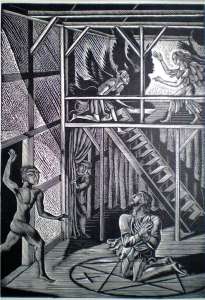
EricRavilious-1At one point today, together with a bunch of theatre folks we wondered when was Marlowe’s Doctor Faustus last staged in Italy.

After some head-scratching, we came to a baffling conclusion: nobody could remember ever seeing or even hearing or reading of any such thing. I’m not saying positively and absolutely that Faustus was never ever staged in the history of Italian theatre – but five well-informed, well-read and well-theatred actors, directors and drama teachers and one Marlowe buff, between the ages of forty and seventy, couldn’t recall one single production…

At the very least, Italian Faustuses must be few and far between.

A little research has yielded, so far, a 1978 tv adaptation called, a little unfortunately, “Il Fausto di Marlowe”, a radio adaptation about the same years, and a 2011 cantata for choir, tenor and orchestra by composer Matteo D’Amico – and nothing else. *

And the last Italian translation seems to be the one by Nemi D’Agostino, back in 1980.

As I said, I’m baffled.

I sort of knew that Marlowe is very little known and even less staged – but somehow I thought to find something more. Something at all, you know.

Which makes our work with Il Palcoscenico di Carta all the more relevant and interesting, if you ask me… But this is not the point. The point is that this made us all want to do it ourselves.

To stage Faustus – or some other Marlowe, come to think of it, but Faustus especially. And not just because nobody else does it, but because it is a great, powerful, deep, unsettling play that bloody well deserves to be staged and known. So we began discussing practicalities, such as a dramatis personae longer than my arm, and the 1604 and 1616 versions, and doubling, and visuals, and cuts perhaps, and would I object greatly to take active part in the thing…

It was mostly idle talk, for today – the sort of what-if games theatre folks will indulge in on a rainy day. And yet…

And yet I wonder if we didn’t put together seeds today. If it’s not something that will grow and bloom into a real project, and if we won’t find ourselves backstage, in some more or less near future, two or three days from first night, and ask each other: “Do you remember that day, when we wondered when was the last Italian Faustus?”

__________________________________

* Unless you want to count Salveti and Trionfo’s 1976 Faust Marlowe Burlesque – a very, very free adaptation mixing up Marlowe, Goethe, Emily Brontë and many others… I don’t want to.

Reading with a tracheitis (or not)

Tags

, ,

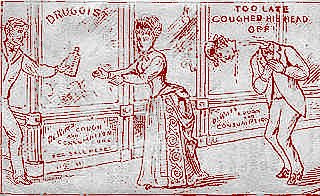
CoughHeadOffI’ve got thracheitis.

Ain’t it just great? I was perfectly well, and suddenly I started coughing like mad, and it hurts when I do, and the doctor says it’s tracheitis.

Trouble is, tonight I should begin doing readings for authors at a small literary festival, but frankly I doubt I’ll be able to. Quite apart from the temperature and everything, even with codeine, I doubt either the authors or the audience would appreciate it, if I were to cough (brayingly) with every third (very scratchy) word… And that’s how things are, right now. Continue reading

Black and White Elizabethans

Tags

, , , , ,

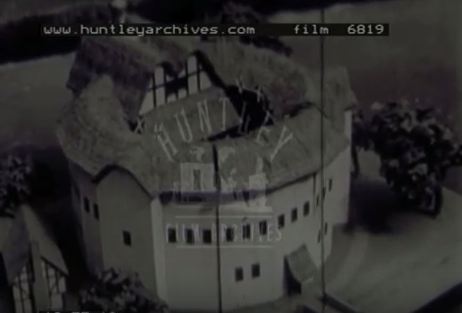
GlobeWhile looking for something else entirely, I stumbled across this little 1950 British film. It’s clearly an educational thing, devised to give the viewer a taste of the Elizabethan era, and especially of the theatre.

Look at the model reconstruction of the Globe, to see how they imagined the old playhouse long before Sam Wanamaker crossed the Pond with his visions, and even longer before the remains of the Rose were excavated, and all they had to go about were drawings and speculation. Continue reading

Il Palcoscenico di Carta Grows Up

Tags

, , ,

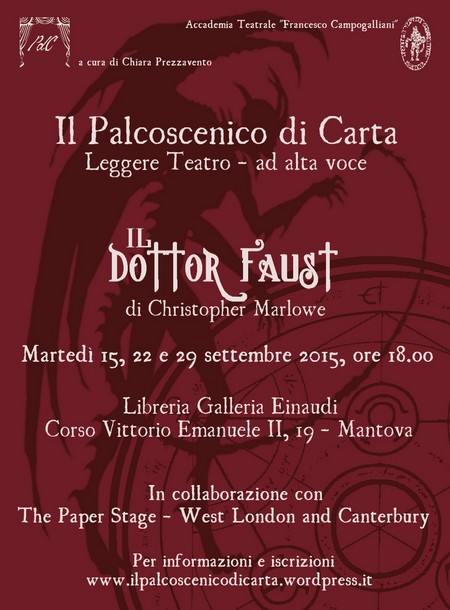
LocandinaFaustusPiccolaSo, il Palcoscenico di Carta/the Paper Stage is back.

For three weeks, starting next Tuesday, we’ll gather in “our” dear bookshop-cum-art gallery to read an Italian translation of Christopher Marlowe’s Doctor Faustus. We’re in a flurry, right now, handing out parts and trying to get the local press to mind us at least a little.

I won’t read any part, this time: my job is introducing the play – and it won’t be the easiest of tasks. You know, there was little reason to do this back in May, when we read Romeo and Juliet. We all know R&J, don’t we. We all know who Shakespeare was, we all know the story, we all know what to expect. Why, we’ve all seen a movie adaptation or three – and very likely also the play itself, once or twice. Continue reading